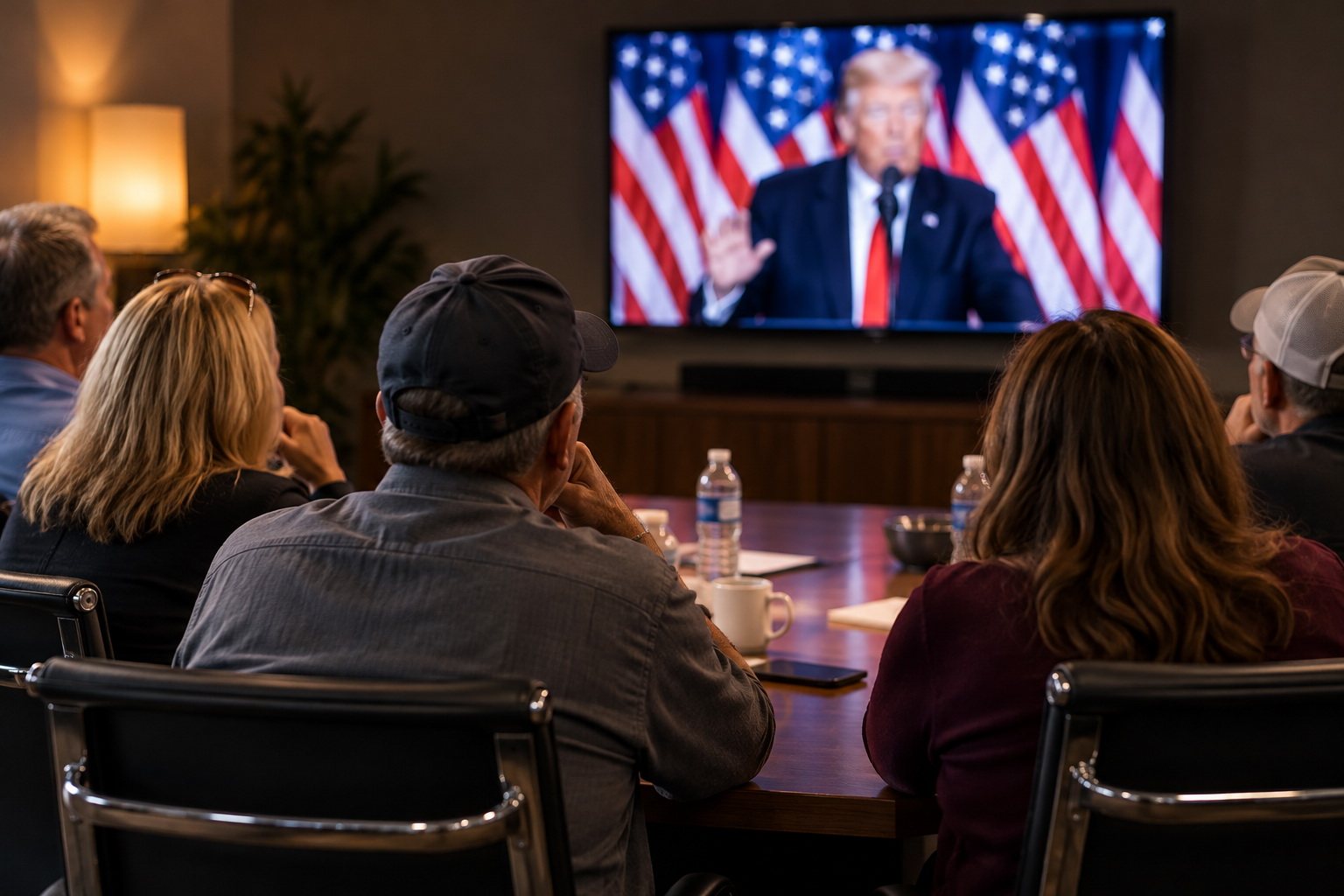
Some Americans who helped return Donald Trump to the White House in 2024 are now expressing sharp criticism of the president, questioning his honesty, his rhetoric and his use of political power.
A new focus group conducted by Republican political strategist Sarah Longwell for The Bulwark revealed striking reactions from former Trump supporters who have since become dissatisfied with his presidency.
The participants were shown a video featuring Trump attacking political opponents and promising to remove ideological enemies from government.
Their responses were anything but enthusiastic.
One participant described Trump's message as "nothing but lies." Others called him power-hungry, narcissistic and increasingly authoritarian.
These weren't lifelong Democratic voters. They were Americans who had voted for Trump just two years earlier.
Trump's Own Words Spark the Backlash
The focus group watched an advertisement in which Trump pledged to remove what he characterized as dangerous political forces from American government and society.
His targets included communists, Marxists, globalists and the news media.
The message presented Trump as a political leader battling an array of enemies threatening the country.
But several participants interpreted the advertisement very differently.
Dina, a 53-year-old participant, described Trump as power-hungry.
Bob, 65, called him a narcissist.
Eddie, from Miami, compared Trump's behavior to that of the communist governments and leaders Trump routinely condemns.
Paul, 63, dismissed the advertisement as "nothing but lies" and joked that he needed Pepto-Bismol after watching it.
Their reactions suggest that even voters who once supported Trump's political style may have limits when confronted with his more aggressive rhetoric.
Criticism Extends Beyond the Economy
Much of the political discussion surrounding Trump's presidency has focused on affordability, inflation, fuel prices and the economic consequences of his policies.
But the focus group revealed another source of dissatisfaction.
Participants objected to the president's language about political enemies and the concentration of power around his administration.
In an October 13 discussion on The New Republic's Daily Blast podcast, host Greg Sargent and political theorist Paul Crider examined whether economic frustrations could be making some former Trump supporters more receptive to concerns about democratic institutions and executive authority.
Crider argued that economic dissatisfaction may prompt voters to reconsider other aspects of a president's conduct that they previously overlooked.
That interpretation remains a political theory rather than a finding established by the focus group.
Nevertheless, the participants' remarks demonstrate that their objections were not limited to household expenses.
One Voter Questions the Republican Party Itself
Perhaps the most consequential reaction came from Ramiro, a Miami participant who expressed frustration extending beyond Trump personally.
Ramiro suggested that Republicans might need to lose power for an extended period to force changes within the party.
His comments reflected dissatisfaction not simply with one politician but with the broader political organization supporting him.
For a president whose political identity has become closely intertwined with the Republican Party, that distinction is significant.
It raises a question about whether dissatisfaction with Trump could also affect voters' attitudes toward other Republican officeholders.
The focus group alone cannot answer that question, but it illustrates why some Republican strategists may be concerned about defections among previously dependable supporters.
What the Focus Group Actually Tells Us
There is an important limitation to these findings.
Longwell's participants were selected because they voted for Trump in 2024 but now disapprove of him.
This was not a nationally representative poll, and the comments do not establish how many Trump voters nationwide share these opinions.
What the discussion does provide is a closer look at how a particular group of disaffected Trump voters explains its change of heart.
Their criticism includes concerns about honesty, political power, rhetoric and the direction of the Republican Party.
Those concerns go beyond the traditional political question of whether voters feel financially better off.
A Warning Worth Examining
Trump has long relied on a confrontational political style, portraying himself as the defender of ordinary Americans against powerful institutions and political opponents.
That approach has attracted considerable support throughout his political career.
But the reactions documented in Longwell's focus group show how the same rhetoric can produce a very different response among voters who once embraced his message.
For these participants, Trump's promises to confront enemies within the country no longer sound reassuring.
Instead, they raise concerns about the president's priorities and the limits of his authority.
The significance of this focus group is not that it proves a nationwide collapse in Trump's support. It is that Americans who previously voted for him are now using unusually harsh language to explain why they have turned against him.
Whether those attitudes extend beyond this selected group will require broader polling and additional evidence.