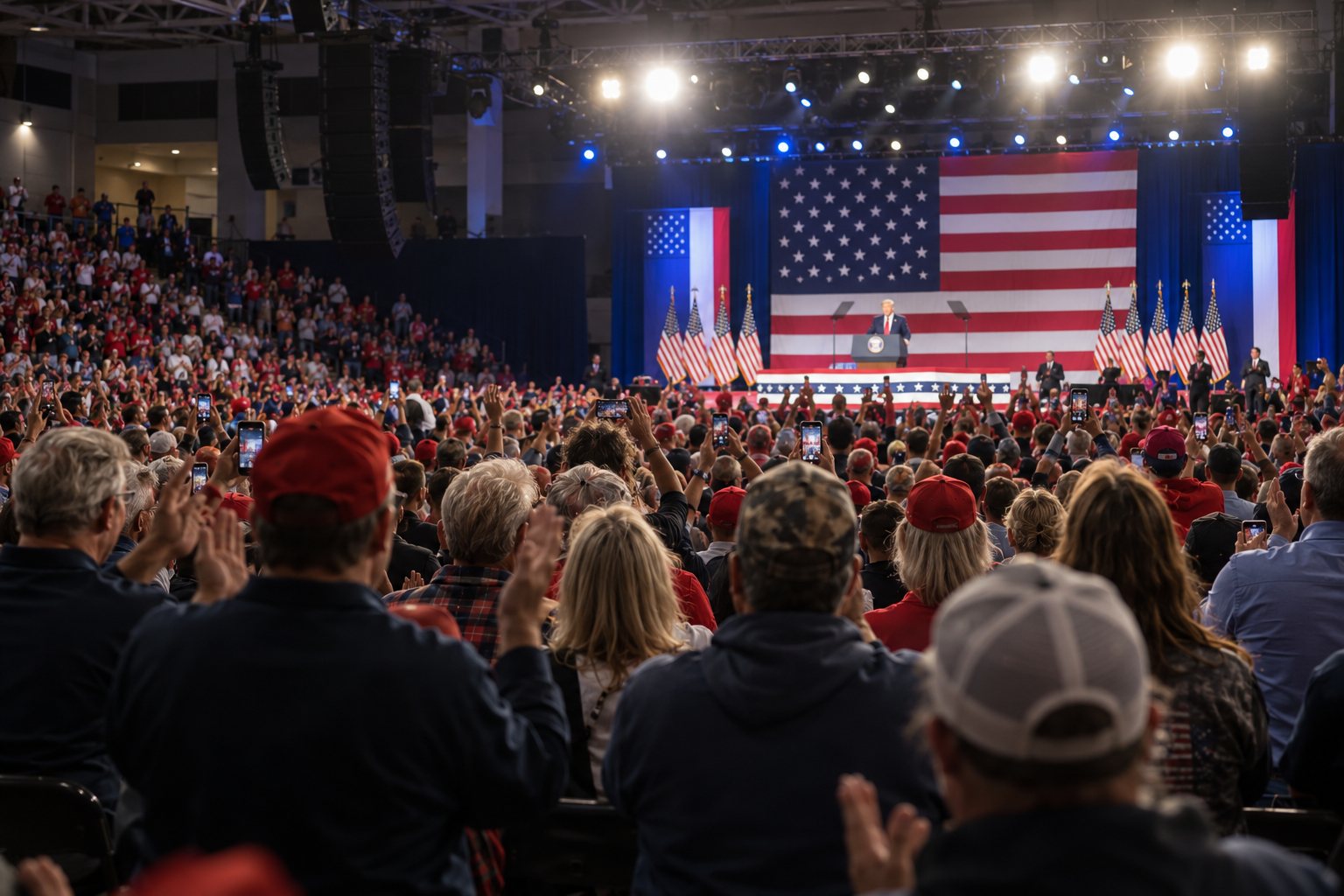
President Donald Trump made an extraordinary observation about his own supporters during a campaign rally in Tennessee on Saturday: He could say something completely ridiculous, and the audience would applaud anyway.
Then, remarkably, the crowd laughed and applauded.
Speaking at the F&M Bank Arena in Clarksville on October 10, Trump was describing the enthusiastic reception he receives at his political rallies when he delivered the remark.
"I could say the stupidest things and you'd clap," Trump told the audience.
The comment was delivered humorously, and Trump immediately clarified that he believed his political positions were based on common sense.
Nevertheless, the exchange quickly attracted attention because of what it revealed about the unusually personal relationship between Trump and his most enthusiastic supporters.
A Remarkable Moment in Tennessee
Trump was appearing in Tennessee to support Republican candidates ahead of the November 3 midterm elections, including Senator Bill Hagerty and gubernatorial candidate Marsha Blackburn.
During his speech, the president recounted a conversation with a friend who had asked how he managed to speak before large audiences without experiencing stage fright.
Trump explained that addressing his supporters was easy because of the affection he received from them.
As he described the atmosphere at his rallies, the audience began cheering and chanting his name.
One attendee shouted an expression of love toward the president.
Trump responded by emphasizing how extraordinary he found the enthusiasm.
Then came the remark about being able to say foolish things and still receive applause.
Rather than treating the comment as criticism, the audience responded enthusiastically.
Trump subsequently insisted that his actual message was grounded in common sense, citing border security, lower taxes, and a strong military.
The full exchange suggests that Trump intended the comment as an affectionate joke about his supporters' loyalty, rather than a serious declaration that his audience would accept anything he said.
But the moment also illustrates how readily a political audience can respond positively to a leader's personality, independently of the substance of a particular statement.
The Difference Between Loyalty and Accountability
Strong emotional connections between political leaders and their supporters are not unusual.
Presidents and presidential candidates frequently develop loyal audiences who applaud familiar messages, respond to personal stories, and identify closely with a leader's public image.
Trump's rallies have long emphasized that relationship.
His speeches frequently include unscripted remarks, personal anecdotes, jokes, political grievances, and direct exchanges with audience members.
Supporters often describe those characteristics as evidence of authenticity.
Critics, however, argue that the same atmosphere can make it difficult to distinguish enthusiastic support from uncritical acceptance.
Saturday's exchange captured that tension.
Trump openly joked that his audience would applaud even an obviously foolish statement.
The crowd's reaction was consistent with his description.
That does not prove that the people attending the rally would accept every claim Trump makes. Applauding a joke is not the same as believing a false statement.
Nevertheless, the episode raises a legitimate question about the relationship between political enthusiasm and scrutiny of presidential claims.
Trump Repeated His False Claim About the 2020 Election
The rally also included another example of Trump's continuing promotion of a demonstrably false claim.
Trump asserted that he had won the presidency three times and that the 2020 election had been stolen through cheating.
He won the presidential elections of 2016 and 2024.
He lost the 2020 election to Joe Biden.
There is no credible evidence that widespread fraud changed the outcome of the 2020 presidential election.
State election officials, recounts, audits, and court proceedings did not substantiate Trump's allegations of an election stolen from him.
Yet Trump continues to repeat those accusations years after the election.
The contrast with his earlier joke is notable.
At the same event where Trump acknowledged that his supporters might applaud even foolish statements, he repeated an election claim that has been extensively investigated and discredited.
The persistence of that claim illustrates why independent verification of political statements remains important, regardless of the enthusiasm of the audience receiving them.
A Rally Built Around Personal Loyalty
The Tennessee event featured an appearance by musician Kid Rock, a longtime Trump supporter who helped energize the crowd.
Trump also spoke about the war with Iran, manufacturing investments, and Republican candidates.
He questioned why he needed to campaign in Tennessee, a state where Republicans have enjoyed substantial electoral success.
At one point, Trump encouraged supporters to approach the midterm elections as though he were personally running.
That request reflected the central role he continues to play in Republican political messaging.
Although Trump is not on the November ballot, his administration's policies and public approval remain prominent subjects in congressional campaigns.
The rally therefore served two purposes: promoting Republican candidates and reinforcing Trump's personal connection with his supporters.
His joke about the audience applauding anything he said fit naturally into the second objective.
The Broader Question of Political Devotion
Political rallies are designed to energize supporters, not to function as independent fact-checking exercises.
Audiences routinely applaud politicians they admire, even when remarks are humorous, exaggerated, or familiar.
But the relationship between political loyalty and accountability becomes more consequential when a leader repeatedly makes factual claims that can be independently tested.
The 2020 election is one example.
Trump's continuing assertions about widespread election fraud have been contradicted by extensive evidence, yet they remain part of his political speeches.
Supporters may embrace those assertions for different reasons. Some believe them, others distrust the institutions that rejected them, and still others may prioritize different aspects of Trump's political agenda.
It would be inaccurate to assume that every person attending a Trump rally shares identical beliefs or accepts every statement he makes.
Still, the president's own description of his audience provides an unusual starting point for examining the strength of personal loyalty in contemporary American politics.
When the President Makes the Observation Himself
What distinguishes Saturday's episode from ordinary political criticism is the source of the observation.
It was not a Democratic opponent accusing Trump supporters of applauding indiscriminately.
It was not a political commentator describing the crowd as unquestioningly loyal.
It was Trump himself, standing before his supporters, joking about the possibility that they would applaud even his most foolish remarks.
And the audience responded with the very enthusiasm he had described.
The exchange was humorous, and its context matters. It should not be mistaken for proof that Trump believes his supporters are incapable of independent judgment.
But it offers a revealing illustration of the relationship he has cultivated with his political base.
For Trump, that relationship has remained a defining feature of his political career.
For the public, the larger issue is whether admiration for a political leader can coexist with rigorous scrutiny of that leader's statements and decisions.
The president's joke produced a moment of laughter and applause. The question it raises about political loyalty and accountability is considerably more serious.