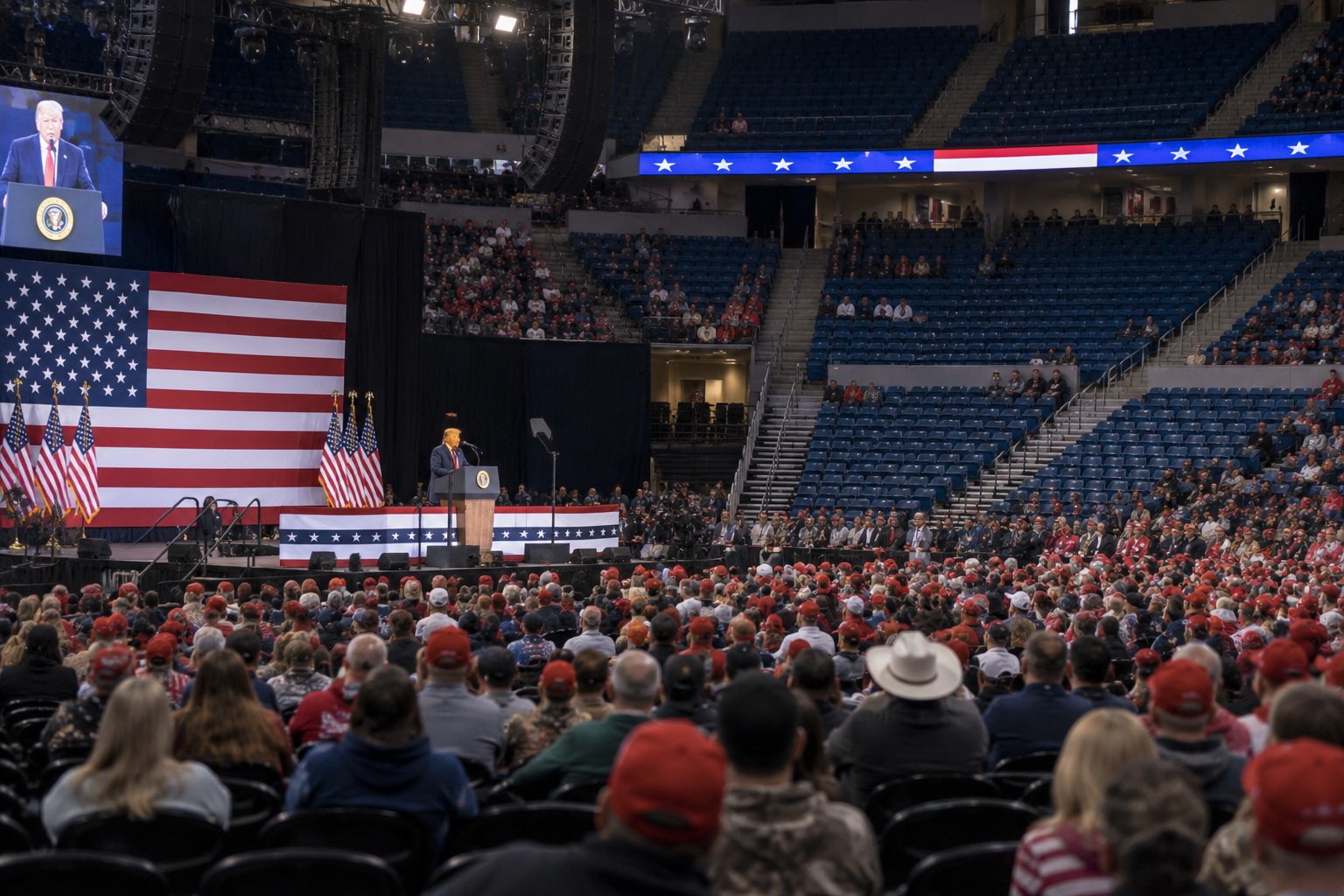
President Donald Trump is spending the final weeks before the November midterm elections campaigning in states he won comfortably just two years ago. But as Republican candidates struggle in the polls, another development is attracting attention: empty seats at rallies that once routinely drew enormous crowds.
Rather than concentrating exclusively on traditional battlegrounds, Trump has visited Republican strongholds including Alabama, Oklahoma, Texas and Ohio, hoping to energize voters who might otherwise stay home on Election Day.
The strategy comes as Democrats show unexpected strength in Republican territory.
Recent New York Times/Siena polling found Democratic Senate candidates leading in Alaska, Ohio and Texas, three states Trump carried by double-digit margins in 2024.
In Ohio, Republican Senator Jon Husted has faced a difficult contest against Democrat Sherrod Brown. A Marist poll showed Brown leading by eight percentage points, prompting Trump to campaign for Republican candidates in the state.
But the crowds themselves are becoming part of the story.
At an October 2 rally in Mobile, Alabama, entire rows of seats remained empty inside the University of South Alabama's approximately 10,000-seat Mitchell Center. It was a striking contrast to Trump's 2015 appearance in the same city, when roughly 30,000 people attended.
In Oklahoma, a rally nearly filled a venue holding approximately 4,900 people, but fell short of the enormous crowds associated with Trump's earlier campaigns.
In Ohio, reporters observed empty upper-deck sections at one event. At a subsequent rally in Youngstown, entire sections of the Covelli Centre remained largely unoccupied.
Trump has continued to describe his rallies as major successes, while Republican National Committee officials maintain that ticket demand and enthusiasm remain strong.
Meanwhile, the president's national approval rating has fallen to 33% in a new ABC News/Washington Post/Ipsos survey, with 66% disapproving of his performance. Democrats also hold an eight-point advantage in the poll's congressional voting preferences among likely voters.
The economic backdrop presents another challenge. Rising prices, the war with Iran and concerns about affordability have become central issues for voters.
Reuters reported that Trump made 13 appearances across 11 states during the first half of October, frequently spending more time discussing political opponents and personal grievances than offering detailed solutions to rising living costs.
Republicans argue that Trump's appearances can motivate supporters who do not normally participate in midterm elections. That strategy could prove important in closely contested races.
Still, the contrast is difficult to ignore. A president who won these states decisively in 2024 is now returning to help Republicans defend territory once considered secure.
And while empty seats alone cannot establish a collapse in political support, the combination of smaller crowds, declining approval ratings and competitive races in traditionally Republican states illustrates the challenges facing the party just weeks before Election Day.
Sources: Reuters, October 15, 2026; The Washington Post, October 12 and 18, 2026; Associated Press, October 17, 2026; ABC News, September 29, 2026; Los Angeles Times, October 3, 2026; The Guardian, October 6, 2026.