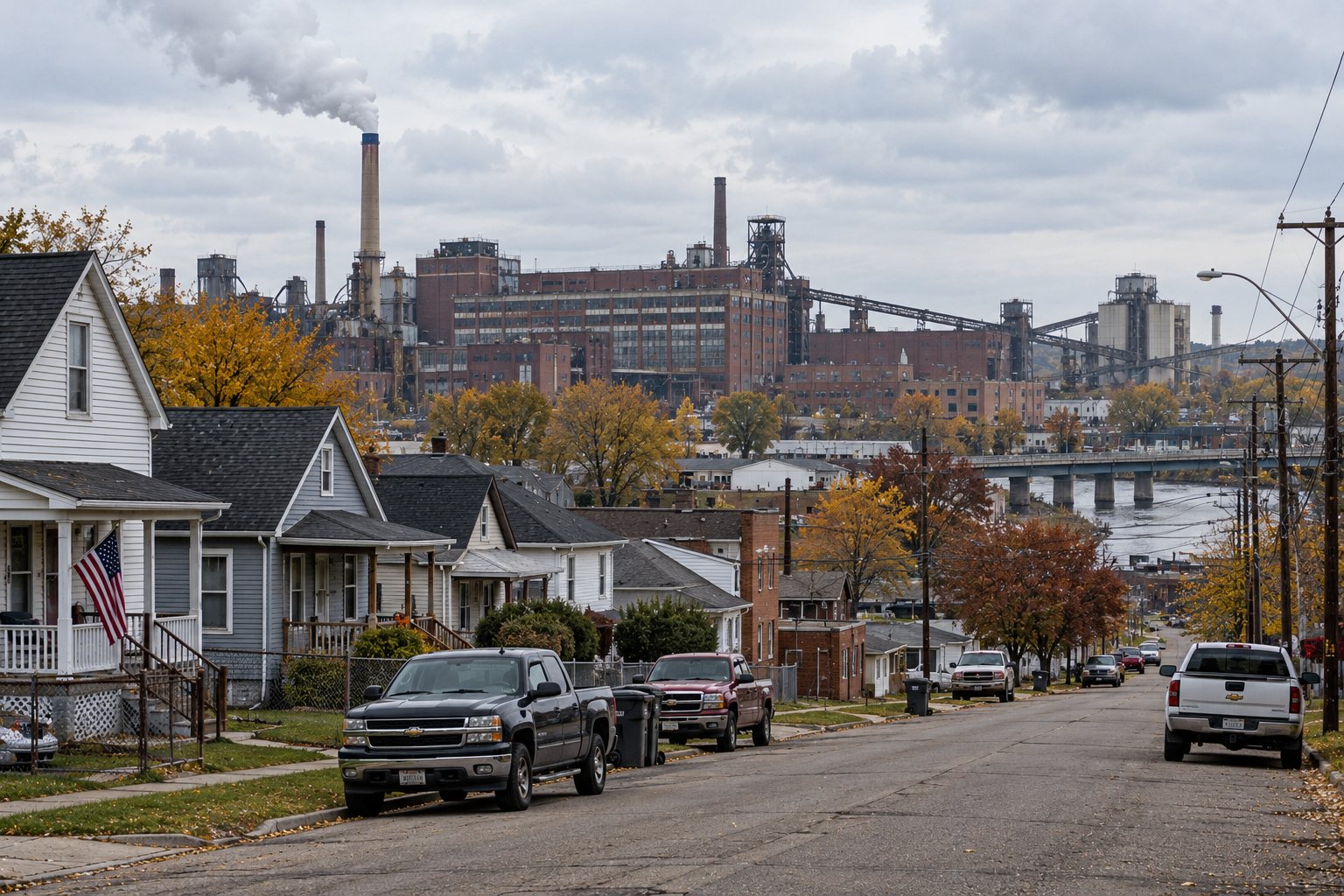
President Donald Trump built much of his political success on the loyalty of working-class Americans, particularly voters across the industrial Midwest who believed his promises to restore manufacturing jobs, protect American industries, and improve their economic futures.
Now, with the November midterm elections approaching, new polling reveals significant cracks in that political coalition.
From Michigan and Wisconsin to Iowa, surveys show declining approval of Trump's presidency, widespread frustration over household finances, and growing dissatisfaction with the direction of the country.
The numbers present a challenge for Republicans who have long depended on these communities for political support.
And the problem extends beyond traditional Democratic voters. Some of the dissatisfaction is emerging among Republicans and voters who previously supported Trump.
Michigan: A Warning From the Heart of America's Auto Industry
Michigan, one of the most important battlegrounds in American presidential politics, offers particularly striking evidence of Trump's declining popularity.
A Marist poll conducted September 24–27 found that just 41% of Michigan registered voters approved of Trump's job performance, while 57% disapproved.
The survey also revealed substantial economic frustration.
Forty-one percent of Michigan voters said their family finances had deteriorated during the previous year. Another 41% reported no improvement.
Only 16% said their financial circumstances had gotten better.
The political implications were evident in voters' attitudes toward the upcoming congressional elections.
Forty-two percent said their vote for Congress would primarily be a vote against Trump, compared with just 20% who said their vote would primarily express support for him.
Democratic congressional candidates also held a nine-point advantage in the statewide generic ballot question, 53% to 44%.
These figures illustrate how dissatisfaction with the president is influencing the political environment in a state central to his working-class appeal.
Wisconsin: Trump's Approval Falls to a New Low
Wisconsin presents another example of the president's difficulties in the Midwest.
A September Marquette Law School poll found Trump's approval rating had fallen to 38%, with 60% disapproving.
That was his lowest approval rating recorded in the poll's Wisconsin surveys across his first and second terms.
The decline was not confined to independent voters.
Among Wisconsin Republicans, Trump's approval fell from 83% in August to 78% in September.
Although he retained majority support among Republican voters, the decline demonstrated that dissatisfaction had reached portions of his own party.
Wisconsin has historically been decided by narrow margins in major statewide elections.
Consequently, even relatively small changes in political enthusiasm or turnout can have substantial consequences.
The polling does not establish how Wisconsin residents will ultimately vote in November, but it demonstrates that Trump's personal popularity has weakened considerably.
Iowa: Even a Republican Stronghold Shows Signs of Discontent
Perhaps one of the most noteworthy developments is occurring in Iowa.
Trump carried Iowa comfortably in the 2024 presidential election, reinforcing the state's reputation as a reliable source of Republican support in presidential contests.
But a September Marist poll found that just 41% of Iowa registered voters approved of his job performance, while 58% disapproved.
The survey also found that 46% of Iowa voters said their family finances had worsened during the previous year.
Only 15% reported improvement.
Forty-three percent said their congressional vote would primarily be a vote against Trump, compared with 22% who described their vote as an expression of support for him.
On the statewide generic congressional ballot question, Democrats received 50% support compared with 45% for Republicans.
These findings are especially notable because they demonstrate dissatisfaction in a state where Trump previously enjoyed substantial electoral success.
However, dissatisfaction with a president does not necessarily translate into a vote for the opposing party. Iowa's individual congressional and statewide contests will also depend on candidates, local issues, and voter turnout.
Trump's Manufacturing Promises Confront Economic Reality
The Midwest's economic history helps explain why these developments matter.
Trump repeatedly promised to restore American manufacturing, revive struggling industrial communities, and protect domestic workers from foreign competition.
His tariff policies have been central to that strategy.
But the economic consequences have been complicated.
Tariffs can protect some domestic producers from foreign competition while simultaneously increasing costs for American manufacturers that rely on imported components and materials.
The Associated Press has documented manufacturing layoffs in several Midwestern states, including Michigan, Iowa, Kansas, and Ohio, involving businesses affected by rising import costs and broader economic pressures.
Among the examples is Howard Miller, the Michigan clockmaker whose closure affected workers who had previously supported Republicans.
The experiences of these workers illustrate the difference between the administration's promises of industrial renewal and the difficulties facing some individual manufacturers.
They do not establish that tariffs caused every manufacturing job loss, but they challenge the suggestion that higher import duties automatically benefit American workers.
For communities whose economic stability depends on factories and industrial employment, the consequences are immediate and personal.
Rising Prices Are Adding to the Frustration
The economic difficulties extend well beyond factory employment.
Americans continue to face elevated prices for food, housing, transportation, and other household necessities.
The war with Iran has added pressure through higher energy costs.
According to Reuters, the University of Michigan's Consumer Sentiment Index fell to 46.3 in October, its third consecutive monthly decline.
The survey's measure of current economic conditions dropped to a record low of 44.7.
The deterioration was especially pronounced among lower-income households and consumers with relatively limited stock-market investments.
That distinction matters in communities where families depend primarily on wages rather than investment income.
A rising stock market does not necessarily provide meaningful financial relief to a household struggling with gasoline, groceries, or monthly bills.
For voters who supported Trump because they expected lower prices and greater economic security, continued financial pressure can create disappointment.
National Polling Reveals Cracks in Trump's Coalition
The Midwestern findings are consistent with broader national polling.
An October Reuters/Ipsos survey found that Trump's approval rating had fallen to 32%.
The survey also revealed a substantial difference in enthusiasm between voters who supported Trump and those who backed Kamala Harris in 2024.
Among former Harris voters, 48% said they were very enthusiastic about participating in the midterms.
Among former Trump voters, the figure was just 30%.
The poll also identified declining support for Trump among men, rural voters, suburban residents, and Americans without college degrees.
These demographic groups have been important components of his political coalition.
A separate Pew Research Center survey found that Trump's national approval rating had fallen to 30%.
Among registered voters, 44% described their upcoming congressional vote as a vote against the president, compared with 19% who described it as a vote in his favor.
The findings suggest that dissatisfaction with Trump has become an important factor in the national political environment.
Losing Enthusiasm Is Different From Losing Votes
There is an important distinction between voters abandoning Trump politically and voters becoming less enthusiastic about supporting Republican candidates.
Many Republicans continue to approve of the president and intend to vote for their party.
Others express dissatisfaction but remain unwilling to support Democrats.
Some may simply be less motivated to participate in the midterms.
That distinction is critical when interpreting the polling.
A decline in presidential approval does not automatically mean that every dissatisfied voter has switched parties.
Nevertheless, the combination of lower approval ratings, economic frustration, and weaker enthusiasm among previous Trump supporters presents an organizational and political challenge for Republican campaigns.
The Midwest Is Testing Trump's Political Promises
Trump's appeal to the industrial Midwest was built on a straightforward message: American workers had been neglected, factories had disappeared, and his administration would reverse the decline.
For many voters, that message resonated because it addressed real economic hardships.
The current polling suggests that significant numbers of Midwestern residents are dissatisfied with the results of his second term.
Michigan voters report worsening household finances. Wisconsin voters give the president historically low approval ratings. Iowa voters express widespread economic frustration despite the state's recent Republican voting history.
These are separate surveys with different populations and margins of error, and none can determine the November election results.
Together, however, they document a broad pattern of dissatisfaction across states important to Trump's political identity.
The central question is no longer simply whether Trump's promises appealed to Midwestern workers. It is whether those workers believe his administration has delivered the economic improvements they expected.
For many respondents in the latest surveys, the answer appears increasingly doubtful.
And for Republicans preparing for the midterms, that dissatisfaction has become an important part of the political landscape.