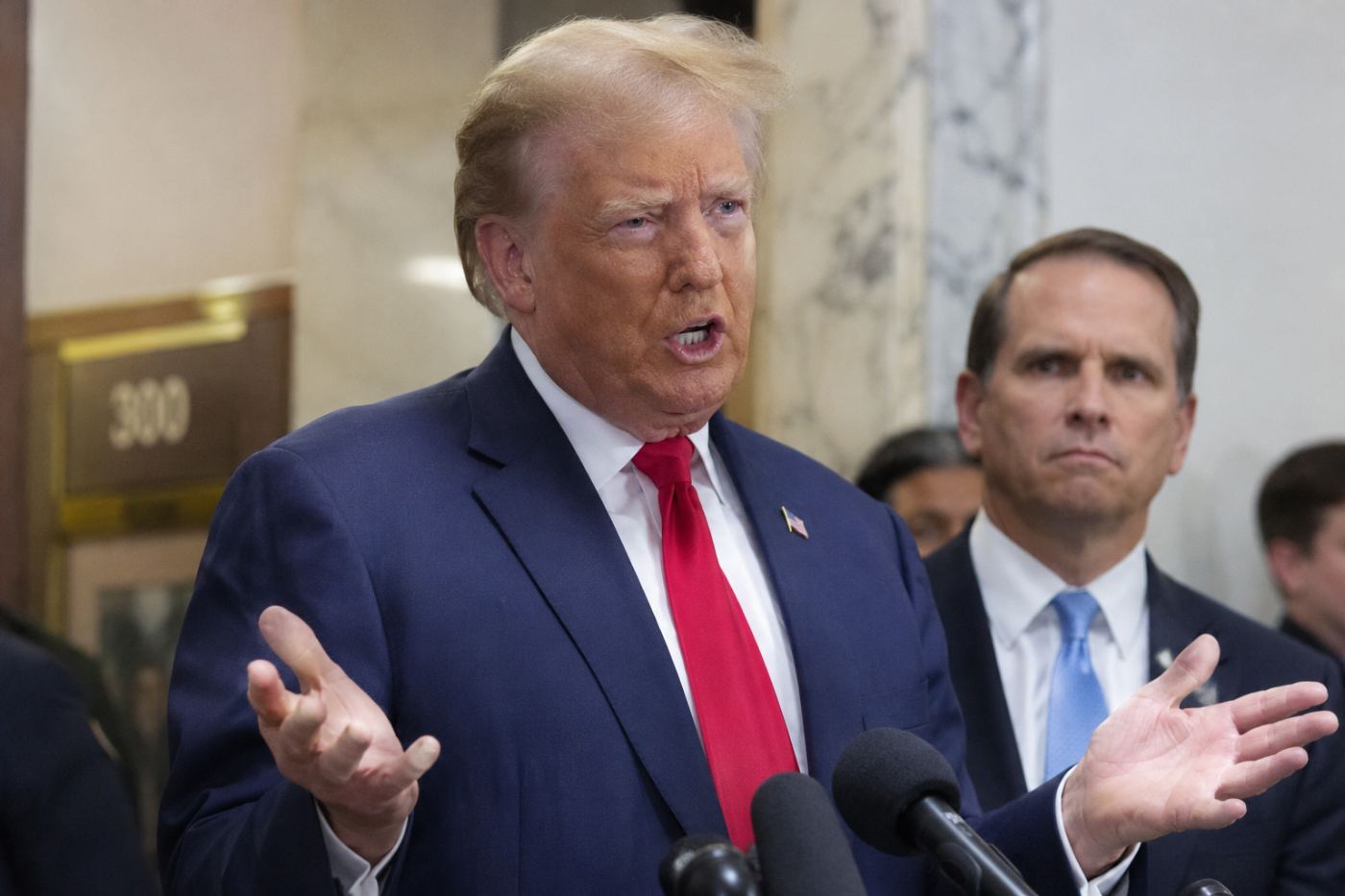
Former President Donald Trump scored a temporary legal victory Thursday when a New York appellate judge suspended restrictions preventing him and his attorneys from publicly criticizing court personnel involved in his ongoing civil fraud trial.
The ruling allows Trump to resume comments about the staff of Judge Arthur Engoron, who imposed the restrictions after the former president publicly attacked his principal law clerk.
The decision does not resolve the underlying fraud allegations or determine whether Trump's attacks on court personnel were appropriate.
Instead, it raises a contentious question: How far can a judge go to protect courtroom employees from public attacks while respecting a defendant's constitutional right to free speech?
A Gag Order Born From Personal Attacks
Engoron imposed the original gag order on October 3 after Trump published a social media post targeting the judge's principal law clerk, Allison Greenfield.
The post included a false allegation about Greenfield's personal life.
Concerned about the consequences of Trump's statements, Engoron prohibited parties in the case from making public comments about court staff.
Trump subsequently violated the order twice, according to the judge, resulting in fines totaling $15,000.
The restrictions were later expanded to attorneys after Trump's legal team repeatedly questioned Greenfield's role in the proceedings.
An Appeals Judge Intervenes
On Thursday, Associate Justice David Friedman of New York's Appellate Division granted an emergency stay of the restrictions.
Friedman cited constitutional and statutory concerns, allowing Trump and his attorneys to comment on court personnel while the appeal proceeds.
Trump's attorneys celebrated the decision as a victory for the First Amendment.
They argue that the former president must be allowed to discuss what they consider political bias within the courtroom.
The judge's decision is temporary and does not constitute a final determination that Engoron's restrictions were unlawful.
The Safety of Court Employees
Attorneys defending the restrictions argue that Trump's public comments have contributed to a threatening environment for court personnel.
Greenfield has reportedly received hostile messages, and court officials have raised concerns about the potential consequences of exposing judicial employees to public harassment.
Trump's lawyers maintain that criticism of the court is protected speech and dispute the justification for restricting it.
The disagreement illustrates the difficult balance between political expression and protecting the administration of justice.
The Fraud Case Continues
The controversy comes during a civil trial brought by New York Attorney General Letitia James.
The lawsuit alleges that Trump, his company, and other defendants repeatedly inflated property valuations and other financial figures to obtain favorable business terms.
Engoron has already found Trump and certain co-defendants liable for persistent fraud. The ongoing trial addresses additional allegations and potential remedies.
Trump denies wrongdoing and maintains that the prosecution is politically motivated.
The temporary suspension of the gag order does not affect those underlying findings or allegations.
A Courtroom Becomes a Political Battleground
Trump has repeatedly used appearances outside the courtroom to criticize the judge, prosecutors, and the proceedings.
His legal team argues that the case raises important questions about political bias and constitutional protections.
Court officials, meanwhile, contend that attacks on judicial employees can create safety risks and interfere with the orderly administration of justice.
Thursday's decision gives Trump additional freedom to speak while leaving the broader dispute unresolved.
Donald Trump has temporarily regained the right to criticize court personnel. Whether those attacks are justified is a separate question—and the fraud allegations against him remain before the court.