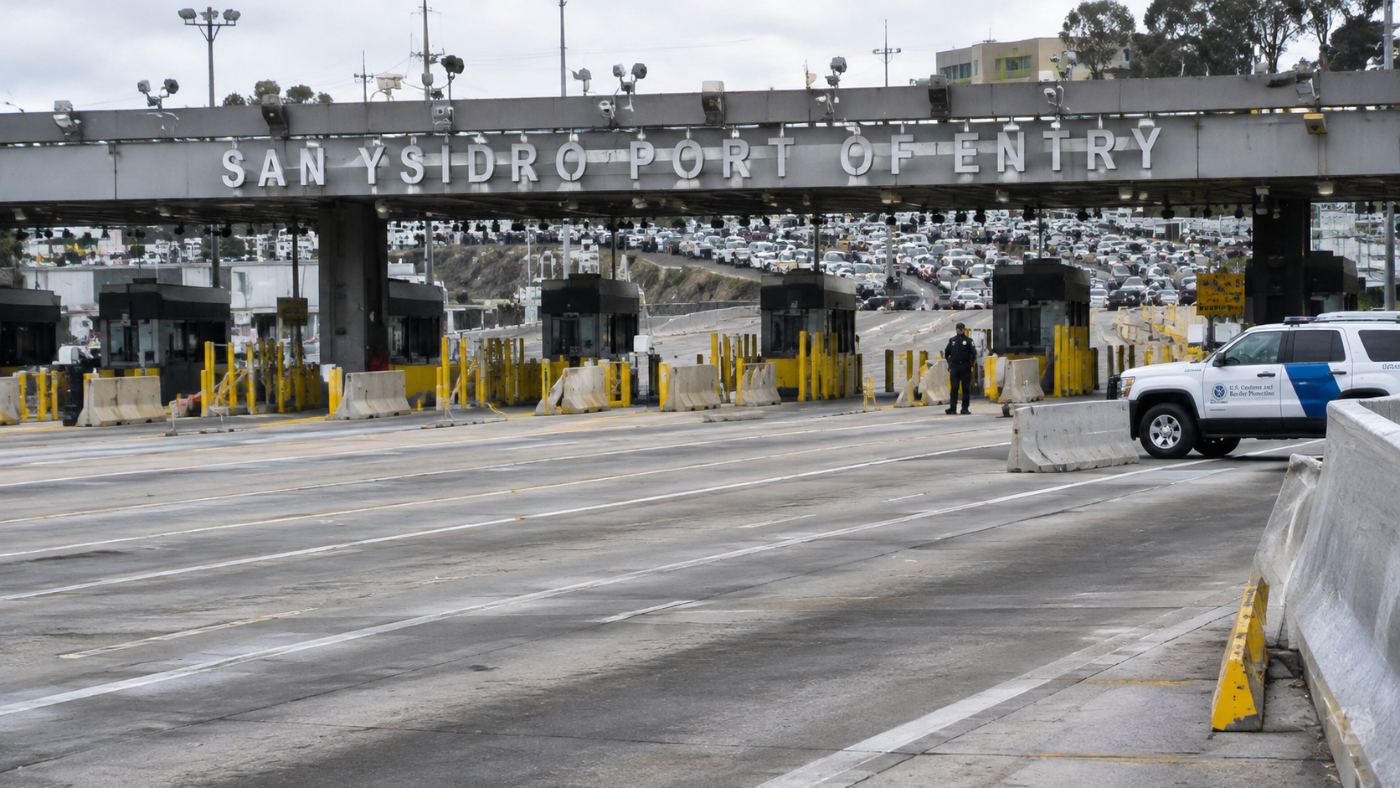
President Donald Trump's aggressive approach to border enforcement collided with economic reality on November 25, 2018, when American authorities shut down the San Ysidro Port of Entry, one of the busiest international border crossings in the world.
The shutdown lasted approximately five hours, stranding travelers, disrupting transportation, and dealing a substantial financial blow to businesses dependent on cross-border commerce.
According to the San Ysidro Chamber of Commerce, the closure resulted in an estimated $5.3 million in lost sales for local businesses.
The disruption demonstrated how border security decisions could carry immediate economic consequences for American workers, retailers, and communities.
Five Hours That Cost Millions
The closure began around 11:30 a.m. after hundreds of Central American migrants approached the border from Tijuana.
Some attempted to cross barriers or enter the United States without authorization. Border Patrol officials reported that agents were struck by rocks and other projectiles.
American authorities responded by deploying tear gas and temporarily suspending vehicle and pedestrian crossings in both directions.
The decision effectively stopped normal operations at a critical international gateway during the busy Thanksgiving shopping weekend.
By the time traffic resumed, the economic damage was already substantial.
American Businesses Pay the Price
The San Ysidro Chamber of Commerce estimated that approximately 650 local businesses lost a combined $5.3 million in sales.
Chamber Executive Director Jason Wells reported that roughly 93% of customers patronizing San Ysidro businesses came from Mexico.
When the border closed, those customers could no longer reach American stores.
Approximately three-quarters of local businesses reportedly closed for the remainder of the day, including retailers at Las Americas Premium Outlets.
Restaurants lost customers. Retailers lost holiday shoppers. Employees faced disrupted shifts.
The $5.3 million figure represented estimated lost sales, not a verified calculation of permanent economic losses. Some purchases may have been postponed rather than canceled.
Nevertheless, the immediate damage to local commerce was substantial.
A Border That Supports Thousands of Jobs
San Ysidro is not simply an immigration checkpoint.
It is an essential economic connection between San Diego and Tijuana.
Approximately 90,000 people normally crossed northbound through the port each day, including commuters, shoppers, students, and workers.
Businesses on both sides depended on that movement.
The broader San Diego–Baja California region supported extensive manufacturing, tourism, retail, and transportation activity.
The San Diego Regional Chamber of Commerce valued commercial exchange between Tijuana and San Diego at approximately $2.1 million daily.
Although much commercial freight uses other crossings, such as Otay Mesa, the San Ysidro shutdown demonstrated how disrupting passenger traffic could immediately damage the regional economy.
Trump's Threats Create Economic Uncertainty
The shutdown followed repeated warnings from Trump that he might close the southern border entirely.
The president argued that aggressive enforcement was necessary to prevent unauthorized immigration and maintain national security.
But business leaders warned that threatening border closures created uncertainty for employers, workers, and investors.
Companies operating across the border rely on predictable transportation and access to customers.
Sudden closures can interrupt deliveries, delay employees, discourage shopping trips, and force businesses to adjust operations.
For small retailers operating on narrow margins, even a few hours of lost holiday business can create serious financial pressure.
A prolonged or widespread closure could have consequences extending far beyond San Ysidro.
The Economic Threat Extends Across America
Mexico was one of America's largest trading partners.
American manufacturers depended on Mexican suppliers, while Mexican factories purchased American components and equipment.
Automobiles, electronics, agricultural products, and industrial machinery routinely crossed the international border.
A complete shutdown of the southern border would threaten those supply chains.
Factories could experience shortages. Agricultural shipments could be delayed. Transportation companies could lose revenue.
American consumers could face higher prices if disruptions became prolonged.
The November 25 incident did not shut down all U.S.–Mexico trade, but it offered a localized demonstration of the costs associated with interrupting cross-border activity.
Security Concerns and Economic Consequences
Customs and Border Protection defended the shutdown as a necessary response to an unstable security situation.
Officials said some migrants attempted to breach the border and threw projectiles at agents.
Protecting personnel and maintaining secure ports of entry are legitimate government responsibilities.
But the economic consequences remained significant regardless of the security justification.
The incident raised questions about emergency planning, coordination with Mexican authorities, and how quickly normal commercial operations could be restored.
Business representatives emphasized that border security and economic stability should not be treated as mutually exclusive goals.
The Humanitarian Crisis Continues
The confrontation also involved thousands of Central American migrants waiting in Tijuana.
Many were seeking asylum after fleeing violence, poverty, and instability.
American agents deployed tear gas during the confrontation, affecting families and children as well as individuals attempting to cross barriers.
The incident highlighted the competing pressures facing border officials: enforcing immigration laws, protecting personnel, processing asylum claims, and maintaining lawful travel.
For local communities, those pressures were accompanied by immediate financial consequences.
November 25: The Price of Closing the Border
The San Ysidro shutdown lasted only hours, but its effects reached far beyond the confrontation at the border fence.
Businesses lost an estimated $5.3 million in sales.
Thousands of travelers were delayed.
Retailers closed during an important holiday shopping period.
Workers and customers found themselves unable to cross an international boundary that normally supported their daily economic activity.
Trump's administration maintained that the closure was necessary for public safety.
But the incident also demonstrated why business organizations warned against treating border shutdowns as a routine political or enforcement tool.
A secure border is important. So is the economic activity that passes legally through it.
On November 25, 2018, the San Ysidro closure showed how quickly disrupting that activity could impose substantial costs on American communities.
And with Trump continuing to threaten broader border closures, the economic risks extended well beyond one afternoon in Southern California.