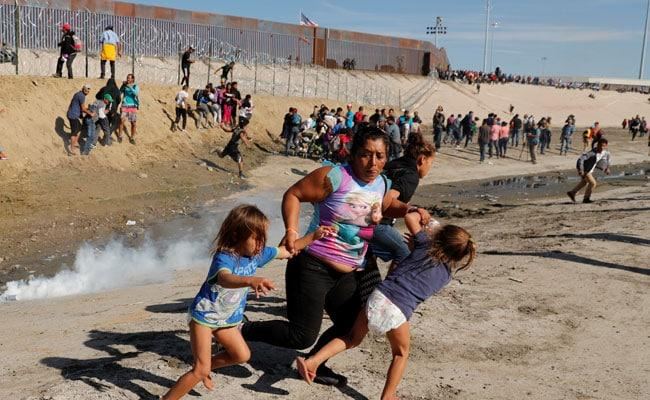
The images were difficult to ignore: frightened children running through clouds of tear gas, desperate parents trying to shield their families, and American border agents confronting migrants along the United States–Mexico border.
On November 25, 2018, U.S. Border Patrol agents deployed tear gas against groups of migrants near the San Ysidro crossing between California and Tijuana, Mexico.
The confrontation occurred during President Donald Trump's increasingly aggressive immigration crackdown, which had turned a caravan of Central American migrants into a major political controversy.
Although authorities said some migrants had thrown rocks and attempted to breach border barriers, the gas also reached families and children who were not participating in those confrontations.
The incident became a powerful illustration of the humanitarian consequences of the administration's border enforcement strategy.
Families Flee Through Clouds of Tear Gas
Thousands of Central American migrants had arrived in Tijuana after traveling through Mexico.
Many were fleeing violence, poverty, and instability in Honduras, Guatemala, and El Salvador.
On November 25, hundreds participated in a demonstration calling for faster processing of asylum applications.
As the crowd approached the border, some individuals attempted to cross barriers separating Mexico from the United States.
American agents responded with tear gas.
Photographs and eyewitness accounts captured families scrambling to escape the chemical irritant.
Children screamed and coughed as gas spread through the area.
One widely circulated Reuters photograph showed Honduran mother Maria Meza fleeing with her two young daughters as tear gas drifted nearby.
The photograph became an international symbol of the confrontation.
Border Patrol Defends Its Actions
U.S. Customs and Border Protection maintained that agents faced a dangerous situation.
Officials said some migrants attempted to force their way through border barriers and threw rocks or other projectiles at personnel.
The agency argued that tear gas was deployed to protect officers and prevent unauthorized crossings.
Those security concerns were real and cannot be dismissed.
Border agents have a responsibility to protect themselves and maintain control of international boundaries.
But the presence of families and children raised a separate question: whether the response adequately protected people who were not threatening officers.
Tear gas does not remain confined to individuals accused of throwing rocks.
Wind can carry chemical irritants across a much larger area, exposing bystanders to their effects.
Trump Turns the Confrontation Into a Political Message
Trump had spent weeks describing migrant caravans as a threat to American security.
He deployed additional military personnel to the border and repeatedly warned that the United States would prevent unauthorized entry.
The president also threatened to close the southern border entirely.
The November 25 confrontation unfolded within that broader atmosphere of heightened enforcement and political rhetoric.
Trump defended the administration's approach, emphasizing the need to prevent illegal crossings.
But immigration advocates argued that the government's policies were worsening conditions for people attempting to seek protection.
The resulting images of children fleeing tear gas brought the human consequences of the confrontation into sharp focus.
Trump's Claims About Injured Agents Face Questions
The following day, Trump claimed that three Border Patrol personnel had been badly injured by rocks and stones.
His statement conflicted with the information Customs and Border Protection Commissioner Kevin McAleenan provided at the time.
McAleenan initially reported that four agents had been struck by rocks but had not suffered serious injuries.
A later Department of Homeland Security inspector general review documented additional injury information, including an agent who suffered a serious injury.
The distinction matters: Trump's immediate account was not supported by the initial official briefing, although subsequent findings established that the confrontation had caused more significant harm than first reported.
The Humanitarian Questions
The incident prompted criticism from humanitarian organizations concerned about the use of chemical irritants near vulnerable families.
Amnesty International questioned the proportionality of the response and called attention to the risks posed by less-lethal weapons.
Immigration advocates also criticized the lengthy waits facing asylum seekers in Tijuana.
American law permits eligible individuals to request asylum, although it does not guarantee that every applicant will receive protection or immediate admission.
The Trump administration argued that stronger enforcement was necessary to maintain border security.
Critics maintained that enforcement policies should not expose children and other bystanders to unnecessary harm.
An International Crossing Shut Down
The confrontation also disrupted one of the busiest international border crossings in the world.
U.S. authorities temporarily closed vehicle and pedestrian access at San Ysidro.
The closure interrupted lawful travel and commercial activity between San Diego and Tijuana.
For several hours, ordinary travelers were unable to use the crossing.
The incident demonstrated how quickly a confrontation involving a relatively small portion of the migrant population could affect an entire border community.
November 25: The Images That Defined the Confrontation
The November 25 incident became one of the most recognizable moments of Trump's immigration crackdown.
Authorities maintained that agents had responded to dangerous behavior, including attempts to breach the border and assaults involving projectiles.
Human rights advocates questioned whether deploying tear gas in an area containing families and children was proportionate to those threats.
Both the security concerns and the humanitarian consequences were central to understanding what happened.
Trump had promised aggressive border enforcement, and his administration defended the actions taken that day.
But the photographs of children fleeing chemical irritants ensured that the confrontation would be remembered for more than a dispute over immigration procedures.
The incident left Americans confronting a difficult question about the government's approach to border security.
How should a country enforce its immigration laws while protecting vulnerable people, including children, from the consequences of that enforcement?
On November 25, 2018, that question was visible in the faces of families running from tear gas along the southern border.