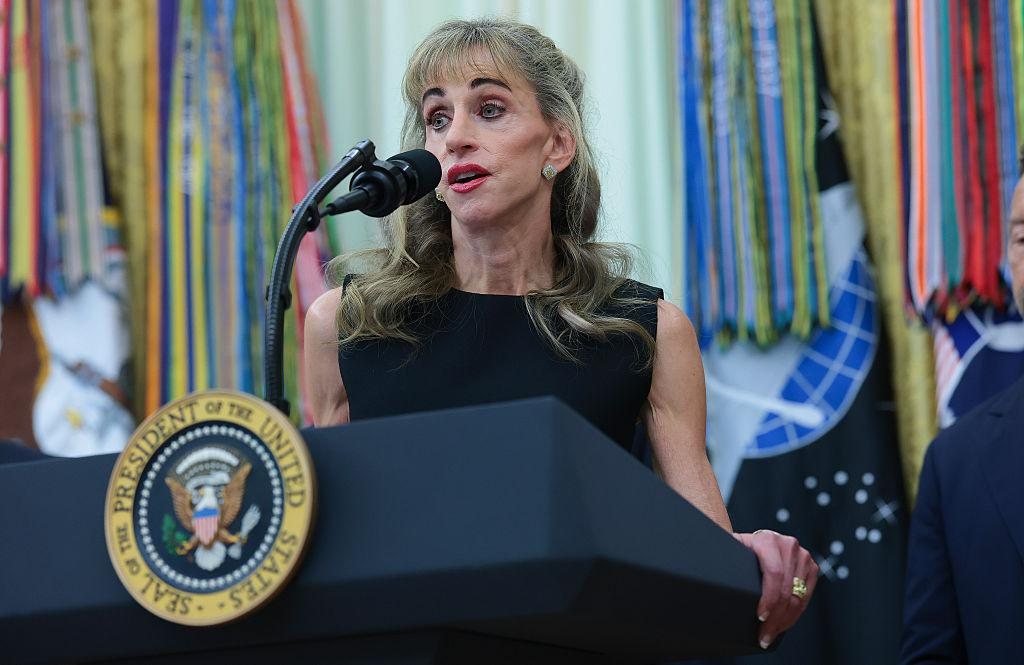
On October 7, billionaire Dell Technologies founder Michael Dell and his wife, Susan, stood in the Oval Office alongside President Donald Trump, celebrating their multibillion-dollar commitment to his signature children's investment program.
The gathering was presented as an uplifting story of philanthropy. Trump praised the couple, Susan spoke about letters from grateful families, and the president even joked about endorsing her for political office.
But behind the smiles and congratulations is a financial relationship that deserves far more scrutiny.
Earlier this year, Trump's investment portfolio purchased millions of dollars in Dell Technologies stock. Just nine days after the initial purchase, Trump publicly encouraged Americans to buy Dell computers. Months later, the Pentagon awarded a Dell subsidiary a contract worth up to $9.7 billion.
And now, the company's billionaire founder is receiving one of the nation's highest technology honors from the same president.
The sequence raises a straightforward question: Where does legitimate government business end and presidential self-interest begin?
First, Trump Bought the Stock
According to federal financial disclosures reported by The Washington Post, Trump's investment portfolio acquired between $1 million and $5 million in Dell Technologies shares on February 10, 2026.
Three additional, smaller purchases followed in March.
Nine days after the February transaction, Trump appeared at a Georgia rally and publicly encouraged Americans to purchase Dell computers, praising the company's products.
That endorsement came from a sitting president whose own financial portfolio had recently acquired a substantial stake in the company.
The White House maintains that independent financial institutions manage Trump's investments. That distinction matters: the public disclosures establish that his portfolio acquired the shares, but do not establish that Trump personally directed the purchases.
Nevertheless, the president's public promotion of a company in which he held a financial interest created an apparent conflict that government ethics experts would later question.
Then Came the $9.7 Billion Pentagon Deal
On May 28, the Defense Department announced that Dell Federal Systems, a subsidiary of Dell Technologies, had received a five-year agreement valued at up to $9.7 billion.
The contract covers procurement of Microsoft software, licenses, and services for the military, intelligence community, and Coast Guard.
The Pentagon described the agreement as an effort to consolidate technology purchasing and reduce duplication.
The $9.7 billion represents the maximum potential value of the agreement, not a guaranteed payment or an immediate transfer of taxpayer funds.
Still, the timing was striking.
A president's investment portfolio acquired millions in Dell shares. The president publicly promoted the company. Then his administration awarded a Dell subsidiary a multibillion-dollar federal agreement.
The contract does not, by itself, prove corruption or preferential treatment. Dell has an established federal technology business, and there is no publicly established evidence that Trump intervened in the award.
But the circumstances prompted warnings from government ethics specialists.
A $6.25 Billion Commitment to Trump's Signature Program
The financial relationship extends beyond stock purchases and government contracts.
In December 2025, Michael and Susan Dell announced a $6.25 billion personal commitment to help fund Trump Accounts, a government-backed investment program for children.
Their pledge was intended to provide $250 contributions for 25 million eligible children.
At the October 7 Oval Office appearance, Michael Dell announced that 10 million accounts had already received funding and said the couple expected to reach the full 25 million by the end of the week.
This is a substantial philanthropic initiative that could provide meaningful financial benefits to millions of families.
But it is also a contribution closely associated with Trump's political brand and one of his administration's signature domestic programs.
The distinction is important. The Dells did not simply donate to an independent children's charity. They committed billions to an initiative that Trump has personally promoted as a major accomplishment of his presidency.
That arrangement has brought the couple considerable presidential recognition and access.
From the Oval Office to a Presidential Medal
The relationship became even more visible this week.
On October 8, Trump awarded Michael Dell the National Medal of Technology and Innovation, one of the nation's highest honors for technological achievement.
Dell received the recognition alongside Microsoft CEO Satya Nadella, while other major technology executives received National Medals of Science.
Michael Dell's accomplishments in the technology industry are substantial. He founded the company that bears his name and helped build it into a global computing business.
But the honor also comes at a time when Dell is deeply involved with Trump's administration.
Michael Dell serves on the President's Council of Advisors on Science and Technology. His company holds major federal business. His family has committed billions to a presidential initiative. And Trump's investment portfolio has held millions of dollars in the company's shares.
Each connection has a separate explanation. Taken together, they present an unusually complicated relationship between a president, a major government contractor, and one of America's wealthiest families.
Ethics Experts Raise Concerns
Government ethics experts have publicly questioned the relationship.
Greg Williams of the Project on Government Oversight told The Washington Post that the circumstances raised significant conflict-of-interest concerns.
The issue is not simply whether the Pentagon's procurement process followed the law.
It is whether a president should retain a financial interest in a corporation while publicly promoting that corporation and overseeing an administration that awards it substantial federal business.
Federal law exempts the president from certain criminal conflict-of-interest restrictions that apply to other executive branch officials. That legal exemption does not eliminate the underlying ethical questions.
The White House has defended Trump's relationship with the Dells, saying his praise reflects their contribution to American children's investment accounts and that his priority is the public interest.
There is no established evidence of an agreement exchanging the Dells' philanthropic commitment for a federal contract, favorable policy, or presidential recognition.
But an absence of proven wrongdoing is not the same as an absence of legitimate questions.
The Questions That Remain
The public deserves to know whether Trump had any knowledge of his portfolio's Dell stock purchases before promoting the company.
It deserves to know whether the president or his senior advisers had any involvement in decisions surrounding Dell Federal Systems' Pentagon agreement.
It deserves transparency about the president's financial interests in companies doing substantial business with the federal government.
And it deserves an explanation of what safeguards prevent presidential financial interests from influencing government decisions.
None of these questions requires assuming that the Dell contract was improperly awarded or that the Dells' philanthropy was insincere.
They arise from the documented overlap of private wealth, public office, government contracting, and presidential influence.
The October 7 Oval Office appearance may have been intended to celebrate an extraordinary charitable commitment.
But the larger story is about a president whose personal financial interests intersect with companies receiving enormous government contracts—and the limited safeguards that exist when the president himself is involved.
The public should not have to rely on presidential assurances to determine whether those interests remain separate.