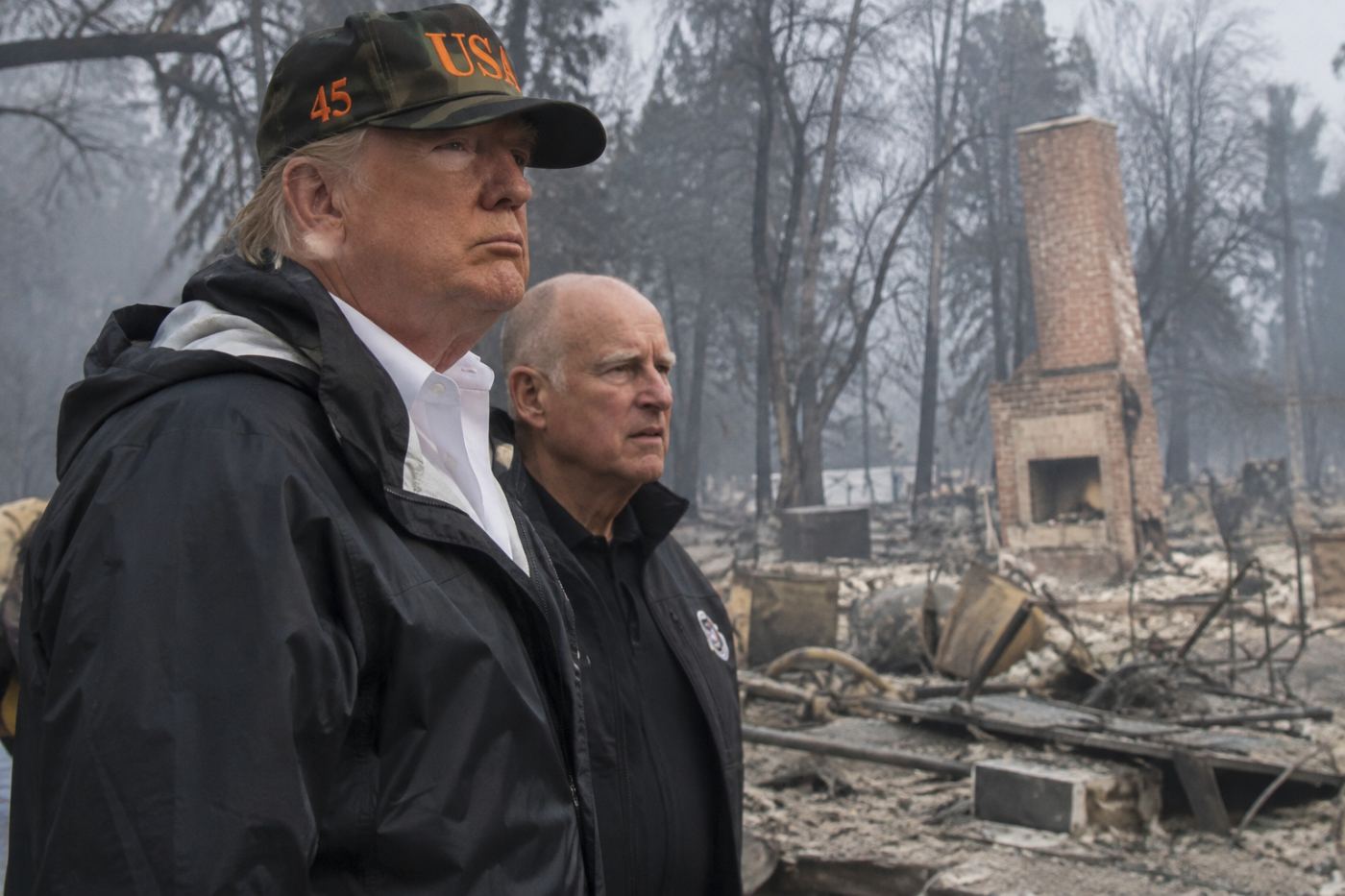
President Donald Trump toured the charred remains of Northern and Southern California communities Saturday, witnessing the destruction of deadly wildfires while continuing to emphasize poor forest management as a central cause of the disaster.
But the president's criticism raises an important question: If inadequate forest management is responsible for California's wildfire crisis, why is Trump directing so much blame toward the state when the federal government itself manages millions of acres of California forestland?
A Community Reduced to Ashes
In Paradise, California, Trump walked through neighborhoods where homes, businesses, and vehicles had been reduced to burned-out shells.
The Camp Fire has killed at least 76 people, with more than 1,000 still reported missing as search crews continue examining the devastation.
Trump toured the destruction alongside California Governor Jerry Brown and Governor-elect Gavin Newsom, promising federal assistance for recovery.
The president also visited areas affected by the Woolsey Fire in Southern California.
Yet even amid the destruction, Trump returned to his familiar argument that inadequate forest maintenance is responsible for California's wildfire problems.
The Federal Responsibility Trump Overlooks
There is a significant problem with the president's criticism.
The federal government manages a substantial portion of California's forestland, primarily through agencies such as the U.S. Forest Service and the Bureau of Land Management.
The state government does not control those federal forests.
California's forests are divided among federal agencies, state and local governments, and private owners. Each has different responsibilities for vegetation management, fire prevention, and land maintenance.
Trump's argument that California has failed to manage its forests therefore leaves out the federal government's own responsibilities.
If forest management is the central issue, the president must also account for the condition of federally managed lands under his administration.
That does not establish that federal management caused the Camp Fire, which began outside the national forest system. It does mean the issue cannot reasonably be reduced to blaming California's state government.
The Climate Question Trump Refuses to Reconsider
During Saturday's visit, reporters asked whether witnessing the destruction had changed Trump's position on climate change.
His answer was no.
The president instead emphasized the need for safer forests and improved management.
Scientists have warned that rising temperatures, prolonged dry conditions, and changes in precipitation patterns can increase wildfire risks.
Forest management matters, but it cannot eliminate the effects of extreme winds, dry vegetation, and increasingly dangerous fire weather.
Trump's repeated emphasis on clearing forest floors addresses only part of a much more complicated problem.
Threatening Aid Before Offering Assistance
The president's visit follows a controversial November 10 statement in which he threatened to withhold federal payments unless California improved its forest management.
The remarks drew criticism from firefighters and state officials who argued that threatening funding during a deadly emergency was inappropriate.
On Saturday, Trump adopted a more cooperative tone, promising federal assistance and praising emergency responders.
Governor Brown welcomed the support, emphasizing the enormous recovery effort ahead.
The Human Cost Behind the Political Argument
For residents of Paradise, the debate over responsibility is unfolding amid unimaginable loss.
Families have lost homes, possessions, businesses, and loved ones.
Emergency crews are searching destroyed neighborhoods while thousands of displaced residents struggle to find shelter.
The disaster demands cooperation among federal, state, and local governments.
It also demands an examination of every factor contributing to California's wildfire danger, including land management, development patterns, extreme weather, and climate change.
Donald Trump is demanding accountability for California's forests. But any serious examination must include the millions of acres managed by the federal government he leads.
The people of Paradise deserve more than political accusations. They deserve answers, assistance, and a comprehensive effort to prevent another catastrophe.