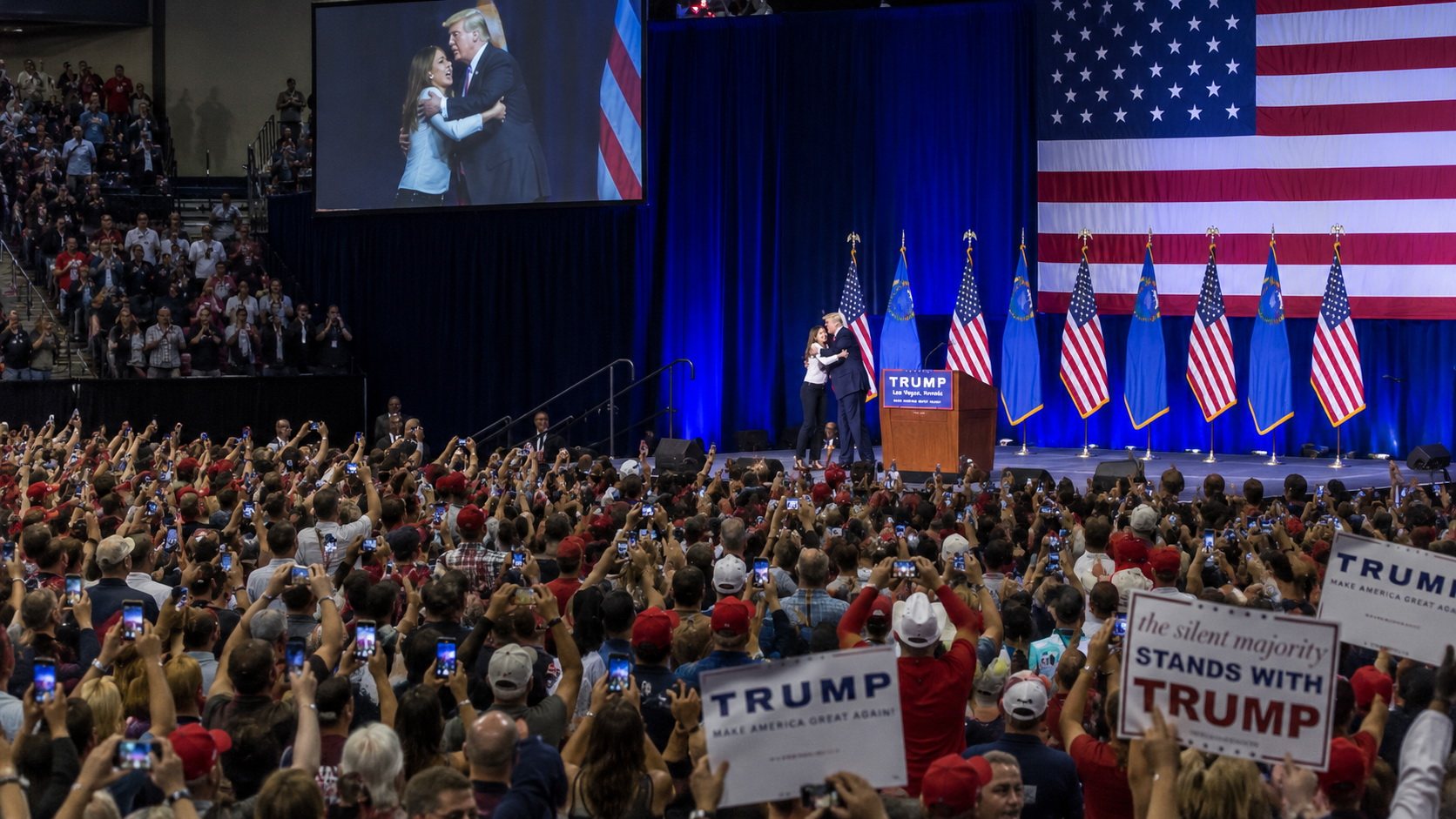
On October 8, 2015, Donald Trump was holding a campaign rally in Las Vegas when he spotted a woman in the audience waving a copy of People magazine featuring his photograph.
He invited her onto the stage.
What happened next became one of the most memorable moments of Trump's first presidential campaign.
"I'm Hispanic, and I vote for Mr. Trump!" the woman shouted, jumping excitedly as the crowd cheered.
Her name was Myriam Witcher, a Colombian immigrant and naturalized American citizen whose enthusiasm for Trump quickly made her an internet sensation.
Trump embraced her, kissed her on the head, and used the encounter to reinforce his claim that Hispanic Americans supported his candidacy.
"And that's my relationship with Hispanics," Trump declared.
A Devoted Supporter
Witcher was not simply a curious spectator.
Following the rally, she appeared on CNN, where she described Trump in extraordinarily enthusiastic terms. She called him a compassionate man and said she believed he had been sent from heaven.
She also supported his hard-line immigration proposals, telling reporters that people who entered the United States illegally should be removed.
Witcher emphasized that she had immigrated legally and become an American citizen.
Her statements attracted attention because Trump had launched his campaign with controversial accusations about Mexican immigrants and proposals for sweeping immigration restrictions.
For Trump's campaign, Witcher's appearance offered a highly visible example of Hispanic support at a time when his immigration rhetoric was drawing widespread criticism.
From Rally Spectacle to Political Symbol
The footage spread rapidly through television broadcasts and social media.
Trump praised Witcher in subsequent interviews, describing her as a remarkable supporter whose appearance had attracted international attention.
But the moment also illustrated how individual supporters could become symbols in a larger political argument.
Witcher's enthusiasm was genuine, according to her own interviews. Yet one person's support could not establish how millions of Hispanic voters felt about Trump's policies.
At the time, polling showed substantial opposition to Trump among Latino voters, particularly over immigration.
Witcher's appearance nevertheless became a memorable part of the campaign's early history.
Did She Eventually Turn Against Trump?
More recently, claims have circulated suggesting that the once-enthusiastic supporter became angry with Trump and publicly criticized his administration.
However, the available reporting does not establish that Witcher herself made such a reversal.
There is no verified statement or documented press conference demonstrating that she has renounced her earlier support.
Her story has also been the subject of misinformation before.
In December 2016, PolitiFact debunked a viral claim that Witcher had been deported following Trump's election. The story was false.
That history makes it particularly important to distinguish documented events from social media claims.
An Unforgettable Moment in Trump's Political Rise
Whatever Witcher's current political views, her 2015 appearance remains a revealing episode in the history of Trump's political movement.
A Colombian immigrant stood beside a presidential candidate whose immigration proposals were generating national controversy and enthusiastically declared her support.
Trump embraced the moment, presenting it as evidence of a broader connection with Hispanic voters.
More than a decade later, the footage remains a reminder of how political campaigns use individual stories to shape public perceptions.
As for Myriam Witcher herself, the question of whether her once-unwavering enthusiasm survived Trump's years in office remains unanswered by reliable public reporting.