The United States is experiencing its worst measles outbreak in 35 years, and the man responsible for overseeing the nation's public health response is Robert F. Kennedy Jr., a longtime vaccine skeptic who spent years promoting doubts about childhood immunizations.
As of October 8, the Centers for Disease Control and Prevention had recorded 4,080 confirmed measles cases in 2026, an increase of 193 in just one week. The country has already surpassed its entire 2025 total, with infections spreading across dozens of states.
For a disease the United States declared eliminated in 2000, the resurgence represents a significant public health setback.
And for Kennedy, who now serves as President Donald Trump's secretary of Health and Human Services, it presents a difficult contradiction: the country is confronting a disease that routine vaccination can prevent, while its top health official continues to challenge longstanding vaccine policies.
A Disease America Had Already Defeated
Measles was once a common childhood illness in the United States. Before widespread vaccination, millions of Americans were infected annually, with hundreds dying and thousands requiring hospitalization.
The introduction of the measles vaccine in 1963 transformed that reality.
By 2000, the United States had officially eliminated continuous domestic transmission of the virus. Imported infections occasionally caused outbreaks, but sustained transmission had been interrupted.
That achievement depended on maintaining high vaccination rates.
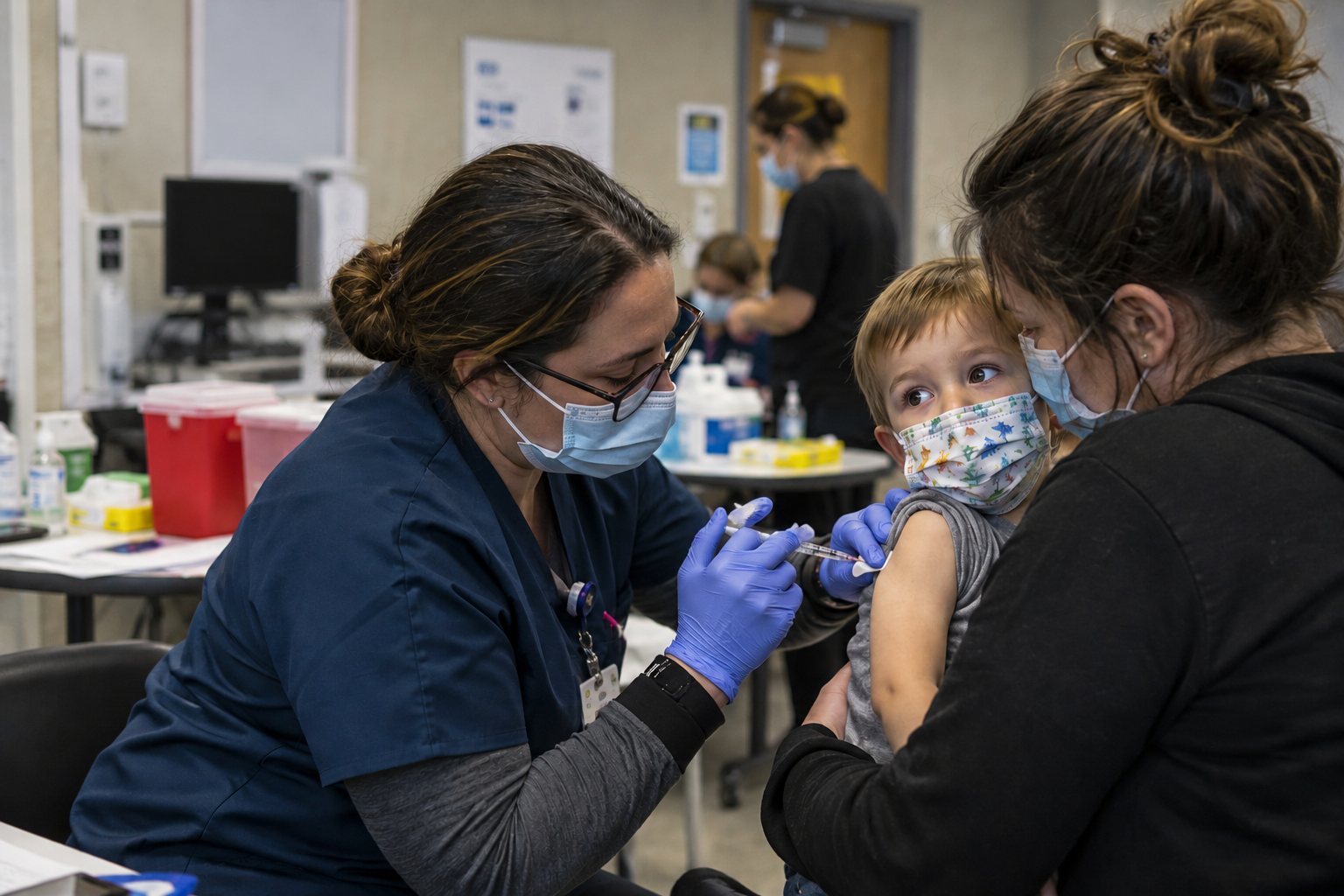
The measles, mumps, and rubella vaccine, commonly known as MMR, is approximately 97% effective against measles after two doses.
But vaccination coverage has been declining.
CDC figures show that MMR coverage among American kindergartners fell from 95.2% during the 2019–2020 school year to approximately 92.4% in 2025–2026.
That decline has left an estimated 280,000 kindergartners at risk.
Measles is extraordinarily contagious. When an infected person enters a room, the virus can remain infectious in the air for up to two hours after that person leaves.
A small decline in vaccination coverage can therefore have serious consequences, particularly in communities where large numbers of children are unvaccinated.
Pennsylvania Becomes an Epicenter
Pennsylvania has emerged as one of the hardest-hit states, reporting more than 1,000 infections and five measles-associated deaths.
South Carolina, Utah, Texas and other states have also experienced substantial outbreaks.
The situation has become serious enough that New York Governor Kathy Hochul declared a disaster emergency on October 5, expanding access to vaccinations and testing.
The United States now faces the possibility of losing its measles elimination designation, an internationally recognized public health achievement maintained for more than a quarter-century.
Behind the statistics are children who have been hospitalized, families dealing with preventable infections, and communities struggling to contain an illness that modern medicine has known how to prevent for decades.
Kennedy's Long History of Vaccine Skepticism
Kennedy's controversial relationship with vaccines did not begin when Trump appointed him health secretary.
For years, he was one of the country's most prominent voices questioning vaccine safety. He led Children's Health Defense, an organization that promoted claims about vaccines that scientists and public health authorities repeatedly challenged.
Kennedy has disputed the established scientific consensus that vaccines do not cause autism, despite extensive research finding no causal connection.
Since taking office, he has pursued significant changes to federal immunization policy, including replacing members of the CDC's vaccine advisory committee and challenging elements of the recommended childhood vaccination schedule.
On October 8, his department announced another initiative focused on investigating reported vaccine injuries.
Studying legitimate vaccine adverse events is an established part of public health oversight. But medical organizations have expressed concern that Kennedy's broader approach could further undermine confidence in vaccines whose benefits are supported by extensive evidence.
The American Academy of Pediatrics continues to support routine childhood immunization and emphasizes that vaccines undergo rigorous safety testing and monitoring.
Does Kennedy Even Support the Measles Vaccine?
Perhaps the clearest illustration of Kennedy's communication problem comes from a September 29 survey released by the University of Pennsylvania's Annenberg Public Policy Center.
The nationally representative survey of 1,904 American adults found that only 31% correctly understood that Kennedy recommends measles vaccination.
Another 29% believed he did not recommend it, while 40% were uncertain.
That means nearly seven in ten Americans either misunderstand or cannot identify the health secretary's position on one of the most important vaccines in modern medicine.
Kennedy has publicly recommended measles vaccination, including in August 2026.
However, researchers have noted that his statements frequently combine support for vaccination with warnings, qualifications, and unsupported claims that can leave the public confused.
At a moment when clear messaging is essential, that confusion has become a public health concern of its own.
Heroin Addiction, a Brain Parasite, and an Unusual Personal History
Kennedy's personal history has also attracted considerable scrutiny.
He has openly discussed a 14-year addiction to heroin, including his eventual recovery. In 1983, he was arrested for heroin possession, an episode that became part of his publicly documented struggle with substance abuse.
Kennedy has subsequently spoken about his recovery and advocated treatment for people suffering from addiction.
His medical history attracted additional attention during his 2024 presidential campaign.
According to a 2012 deposition reported by The New York Times, Kennedy said doctors investigating memory problems and mental fog had discovered evidence of a parasitic worm in his brain.
Kennedy said one physician believed the parasite had entered his brain, damaged tissue, and died.
Medical specialists later explained that parasites of this type generally do not literally consume brain tissue, although infections can cause inflammation and neurological complications.
Kennedy's campaign said the infection had resolved years earlier and that he had fully recovered.
He even joked publicly about the episode during the presidential campaign.
Neither his history of addiction nor the reported parasite establishes that he is medically unfit to serve. His recovery from addiction is not evidence against his professional qualifications.
The relevant question is whether the person directing America's public health agencies makes decisions grounded in reliable scientific evidence.
A Public Health Crisis Under His Watch
Kennedy did not create America's vaccine hesitancy problem by himself.
Vaccination rates were declining before he became health secretary, and misinformation about vaccines has circulated for decades.
But Kennedy was an influential participant in that movement long before joining the Trump administration.
His current position gives him considerable influence over the agencies responsible for vaccine recommendations, disease surveillance, public health communications, and federal health policy.
Public health researchers have warned that mixed messaging from national leaders can make it more difficult to rebuild vaccination confidence.
The latest measles figures demonstrate the urgency.
America recorded just 85 measles cases in 2000, the year the disease was declared eliminated. In 2026, the country has already surpassed 4,000 confirmed infections.
That is not simply a statistical change. It represents the return of a dangerous infectious disease that had largely disappeared from everyday American life.
The Question Kennedy Must Answer
Kennedy has spent much of his public career challenging the medical establishment and raising questions about vaccine safety.
Now, as health secretary, he is responsible for helping contain a disease for which vaccination remains the most effective preventive measure.
His supporters argue that he is bringing overdue scrutiny to vaccine safety and demanding greater transparency from public health institutions.
His critics contend that his history of promoting vaccine skepticism has helped weaken the public confidence necessary to prevent outbreaks.
The available evidence establishes that declining vaccination coverage is contributing to the resurgence of measles. It does not establish that Kennedy alone caused the outbreak.
But responsibility for the federal response now rests with his department.
With more than 4,000 infections, children hospitalized, and measles-associated deaths reported, the question is no longer theoretical: Can a health secretary who spent years undermining confidence in vaccines effectively lead the country through a vaccine-preventable disease crisis?
The answer will be measured not in political speeches, but in vaccination rates, infections prevented, and lives saved.