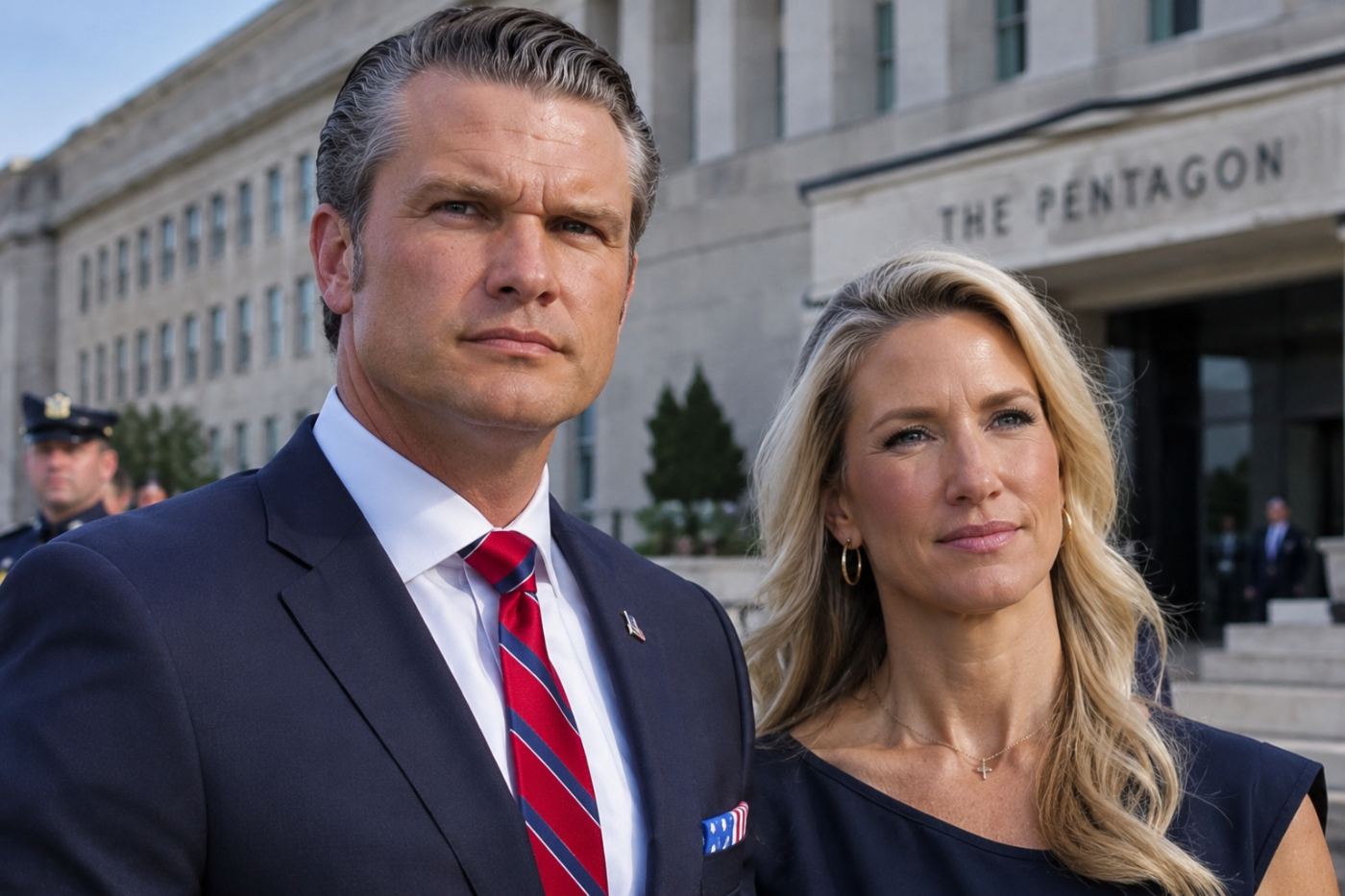
Defense Secretary Pete Hegseth is facing renewed scrutiny after financial disclosures revealed that his wife, Jennifer Hegseth, received consulting payments from a politically connected Washington firm that also represented defense giant Lockheed Martin.
The arrangement raises questions about potential conflicts of interest involving the family of the official responsible for overseeing America's enormous military budget.
According to reporting by Politico, Jennifer Hegseth received compensation from Watchtower Strategy, a consulting and public affairs firm with close connections to President Donald Trump's political network.
Lockheed Martin, one of the nation's largest defense contractors, was among Watchtower's clients in 2025.
The payments appeared in Pete Hegseth's annual financial disclosure, although the filing did not reveal how much his wife received.
Watchtower was established in January 2025 and includes several prominent Republican figures, including former House Speaker Kevin McCarthy and political operatives Jeff Miller, Arthur Schwartz, Dan Conston, and Brian O. Walsh.
The firm's connections to influential Republican officials have made it a notable presence in Washington's lobbying and consulting industry.
Jennifer Hegseth, a former Fox News producer with approximately 18 years of television experience, has reportedly played an unusually influential role in her husband's Pentagon activities.
Despite holding no official government position, she has participated in sensitive discussions and assisted with communications involving senior Defense Department personnel.
Earlier reporting by The Washington Post described her involvement in arranging media appearances, communicating with Pentagon staff, and meeting with candidates for senior positions.
She was also reportedly included in a private Signal messaging group through which her husband shared details concerning planned American military strikes in Yemen.
Her proximity to Pentagon decision-making makes the newly disclosed consulting relationship particularly noteworthy.
Watchtower defended the arrangement, explaining that Jennifer Hegseth assisted the firm with navigating conservative television media.
A company spokesperson insisted that she did not interact with clients or provide advice concerning defense matters.
The firm declined to say whether she continues working for Watchtower.
The Pentagon also rejected suggestions of wrongdoing.
Spokesperson Sean Parnell maintained that Pete and Jennifer Hegseth comply with applicable ethics laws and regulations.
Nevertheless, the disclosure adds to earlier concerns about the family's financial connections to defense contractors.
In January 2025, Senator Elizabeth Warren questioned Hegseth about his wife's investments in major Pentagon contractors, including Lockheed Martin and Northrop Grumman.
Warren warned that financial relationships involving defense companies could create conflicts between private interests and government responsibilities.
The latest disclosure introduces a separate financial relationship involving a consulting firm with a major defense contractor as a client.
It does not establish that Lockheed Martin directly paid Jennifer Hegseth, that she influenced Pentagon contracting decisions, or that any laws were violated.
Those distinctions are important.
But the arrangement nevertheless raises legitimate questions about transparency, access, and whether adequate safeguards exist to separate private financial relationships from official military decision-making.
Among the unanswered questions are the amount Jennifer Hegseth received, the duration of her consulting work, and whether Pentagon ethics officials reviewed the arrangement.
The Pentagon oversees hundreds of billions of dollars in defense spending annually, with companies such as Lockheed Martin competing for lucrative government contracts.
Even the appearance of overlapping financial interests can undermine public confidence in procurement decisions.
For an administration that has repeatedly promised to eliminate Washington's culture of insider influence, the disclosure presents an uncomfortable test of its own transparency standards.
Jennifer Hegseth's consulting work may have been entirely legitimate.
But when the defense secretary's spouse receives payments from a firm serving a major Pentagon contractor while reportedly maintaining unusual access to military leadership, the public deserves a complete explanation.
The central question is not whether wrongdoing has already been proven.
It is whether the administration has provided enough transparency to demonstrate that private financial interests are being kept separate from the decisions affecting America's national defense.