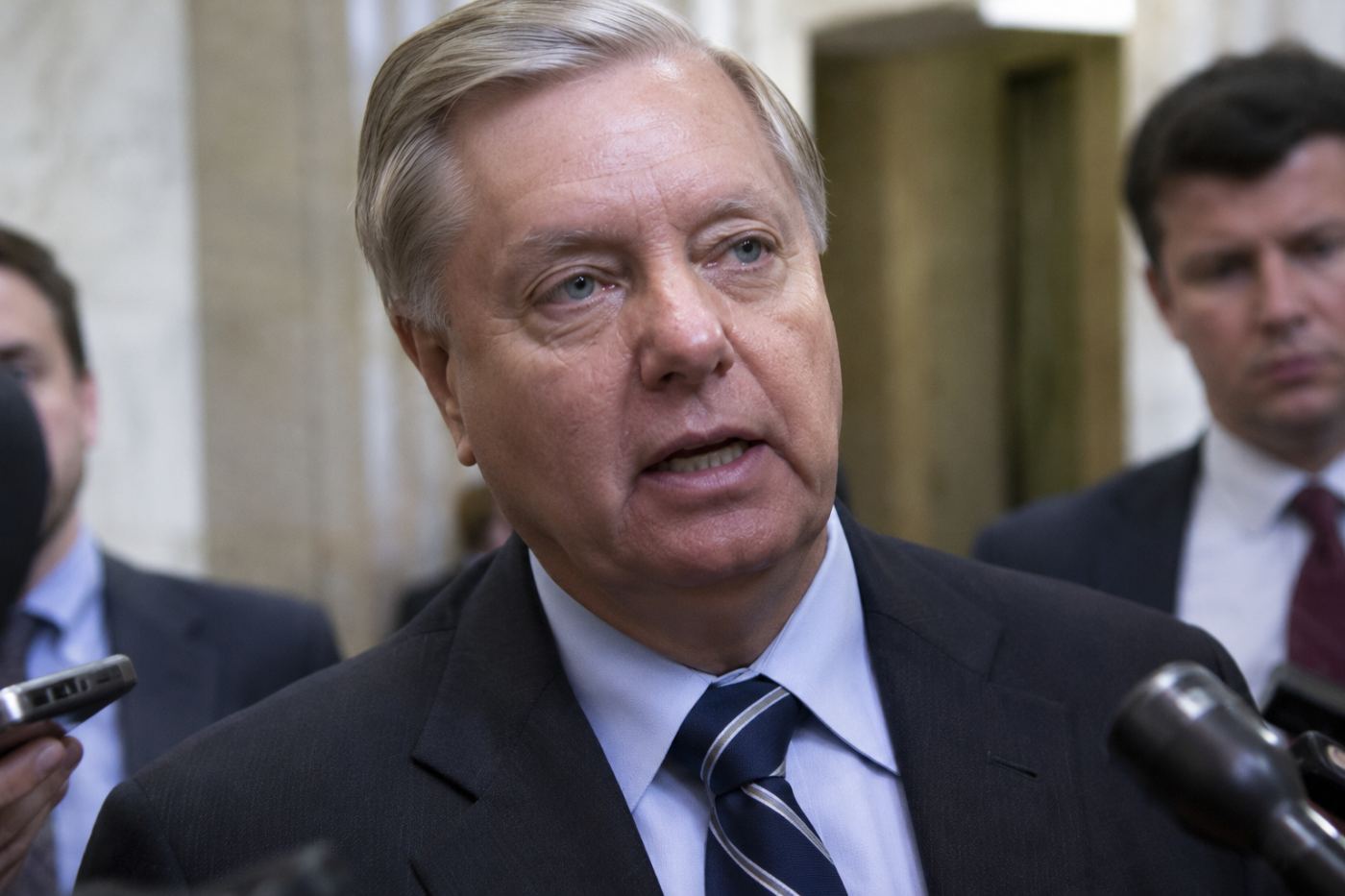
The effort to challenge Donald Trump's election defeat has taken a disturbing turn in Georgia, where Republican Secretary of State Brad Raffensperger says Senator Lindsey Graham questioned whether entire groups of legally cast absentee ballots could be rejected.
The allegation places one of Trump's most prominent congressional allies at the center of a controversy over possible political interference in the presidential election.
Graham denies attempting to discard legitimate votes. But Raffensperger's account raises serious questions about how far Republican officials are willing to go as Trump continues refusing to acknowledge Joe Biden's victory.
A Phone Call That Raises Serious Questions
According to Raffensperger, Graham contacted him last Friday to discuss Georgia's procedures for verifying signatures on absentee ballots.
The conversation reportedly went beyond routine questions about election security.
Raffensperger says Graham asked whether he had the authority to reject all absentee ballots from counties where signature verification revealed higher rates of discrepancies.
Such an action could potentially invalidate thousands of votes, including ballots legally submitted by eligible Georgia voters.
Raffensperger interpreted the senator's questions as an attempt to encourage him to discard legitimate ballots.
Graham disputes that interpretation, insisting he was seeking information about election procedures rather than advocating the rejection of lawful votes.
Nevertheless, the allegation is extraordinary: A sitting United States senator, with no authority over Georgia's election administration, contacted the state's chief election official while his political ally was losing a closely contested presidential race.
An Eyewitness Supports Raffensperger's Account
The controversy intensified Tuesday when Gabriel Sterling, a senior official in Georgia's secretary of state's office, publicly described what he heard during the conversation.
Sterling confirmed that Graham raised questions about whether ballots from counties with significant signature discrepancies could be excluded.
His account lends support to Raffensperger's description of the discussion, although it does not independently establish Graham's intentions.
The distinction matters.
There is a legitimate difference between investigating election procedures and encouraging officials to invalidate votes without evidence that those ballots were unlawfully cast.
The question is whether Graham's intervention crossed that line.
Trump Is Losing Georgia
The dispute comes as Biden maintains a lead of approximately 14,000 votes in Georgia.
The state is conducting a statewide hand audit of nearly five million presidential ballots, with certification scheduled for November 20.
Trump has repeatedly attacked Georgia's election administration, alleging widespread fraud without presenting substantiated evidence sufficient to reverse the result.
Raffensperger, himself a Republican who supported Trump, has defended the integrity of the election and pledged to follow state law.
His refusal to embrace the president's allegations has made him a target of criticism from fellow Republicans.
He has also reported receiving death threats.
The spectacle is remarkable: A Republican election official is defending votes cast under Republican-administered procedures while prominent members of his own party question whether those votes should count.
Lindsey Graham's Changing Role
Graham has become one of Trump's most dependable defenders in Washington.
As chairman of the Senate Judiciary Committee, he occupies a powerful position within the federal government.
But that position does not give him authority to determine which ballots Georgia may count.
Graham says his questions concerned election integrity and the rules governing absentee ballots, particularly with Georgia's January Senate runoff elections approaching.
His explanation deserves to be reported. So does the concern that his intervention could have encouraged the rejection of lawful votes during an ongoing presidential count.
The senator's political relationship with Trump makes the circumstances especially sensitive.
The Broader Effort to Challenge the Election
Georgia is hardly the only state experiencing pressure over its presidential results.
Trump's campaign and Republican allies are pursuing legal challenges in several battleground states, questioning voting procedures and seeking to delay or prevent certification.
Many of those challenges focus on heavily Democratic counties.
The Georgia controversy illustrates a particularly troubling possibility: that officials could be encouraged to reject large groups of ballots based on procedural allegations rather than proof that individual votes were invalid.
Such a strategy could disenfranchise legitimate voters while changing the outcome of an election.
There is no established evidence that Trump personally directed Graham's call. But the conversation occurred within a broader political effort to challenge Biden's victory.
When Election Integrity Becomes Election Interference
Americans have every right to expect accurate elections, transparent procedures, and investigations of credible irregularities.
But election integrity cannot become a justification for discarding legally cast ballots simply because the results disappoint powerful politicians.
Raffensperger has a legal responsibility to administer Georgia's election according to state law, regardless of which candidate benefits.
Graham has the right to ask questions. He does not have the right to dictate Georgia's results.
The allegation now demands scrutiny, particularly because it involves a senior senator contacting a state election official during a closely contested presidential race.
Donald Trump is refusing to accept defeat. His allies are questioning the votes that produced it. And Georgia's Republican secretary of state is publicly warning that the pressure has extended to the possible rejection of lawful ballots.
The fundamental issue is no longer simply who won Georgia. It is whether political pressure will be allowed to interfere with the votes of the people who decided its election.