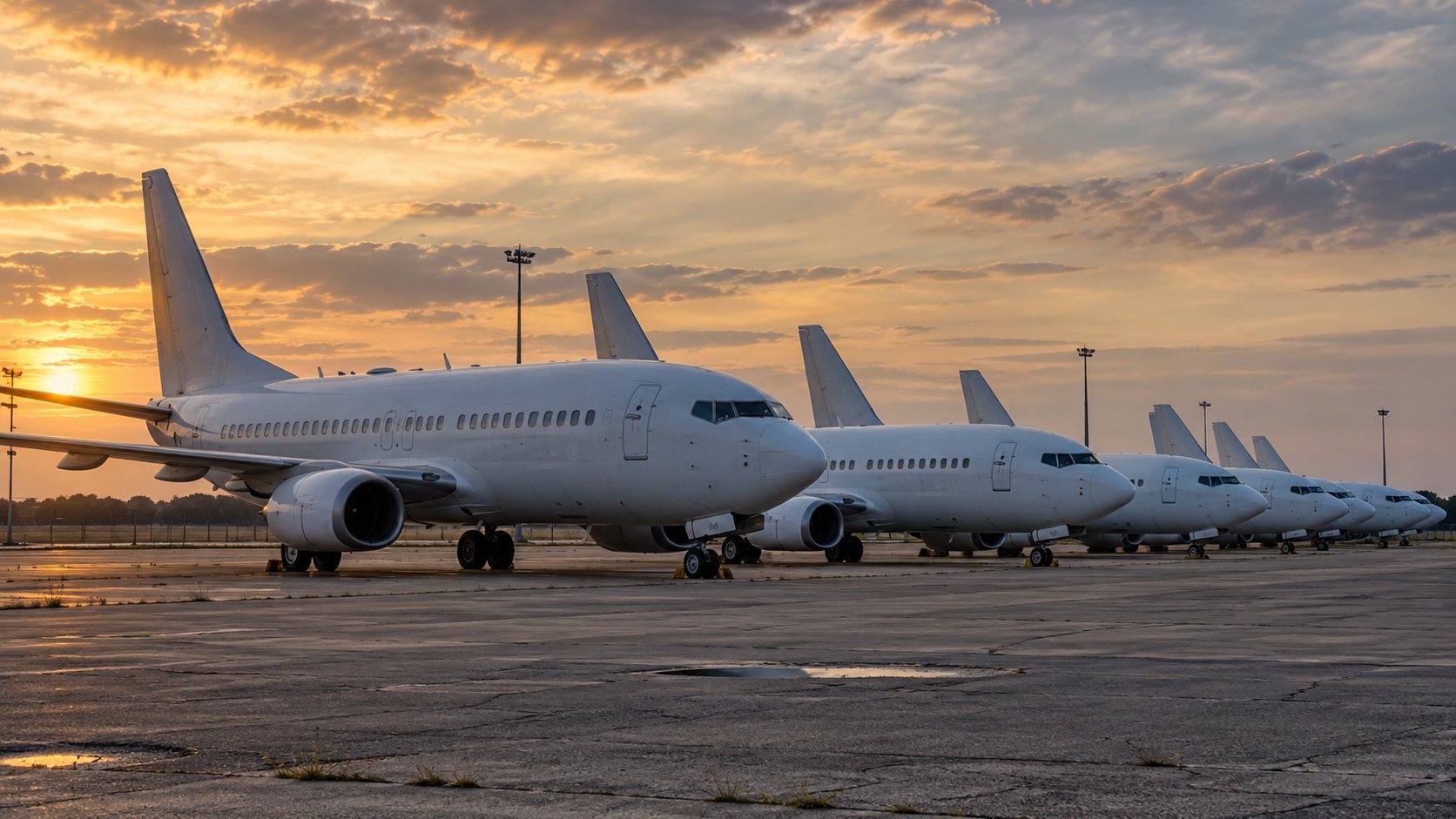
The Trump administration spent nearly half a billion dollars purchasing aircraft that it claimed were urgently needed to accelerate deportations. Months later, there is still no public evidence that those aircraft have transported a single deportee.
But the federal government has continued spending money on the planes.
And remarkably, some of that additional money is going to the same company that supplied them.
At the center of the controversy is William Walters, a businessman, former State Department official, and Trump supporter whose company, Daedalus Aviation Corporation, received a $464 million no-bid contract from the Department of Homeland Security.
Now, congressional investigators have revealed that DHS also paid Daedalus more than $2 million in May and another $2 million in June to store the aircraft.
The arrangement raises an obvious question: How did an emergency government purchase intended to increase deportations become a multimillion-dollar aircraft storage operation benefiting the original contractor?
An Emergency That Apparently Could Wait
Beginning in late 2025, DHS moved to purchase 10 aircraft, including seven Boeing 737 passenger jets and three luxury business jets.
The department justified bypassing normal competitive bidding procedures by claiming the aircraft were urgently needed for immigration enforcement.
The administration argued that owning aircraft would make deportation operations more efficient, reduce reliance on charter companies, and ultimately save taxpayers money.
But following the purchases, most of the aircraft remained parked for months.
The seven passenger jets were stored at Chennault International Airport in Lake Charles, Louisiana, rather than being immediately deployed for the deportation operations used to justify their purchase.
In August, DHS said some of the aircraft were undergoing maintenance and that two were expected to begin deportation flights.
Yet by the time senators renewed their investigation in October, there was still no public documentation establishing that the purchased aircraft had actually been used to deport anyone.
The distinction is important. ICE continues to conduct deportation flights using other aircraft, including chartered planes. The controversy concerns the expensive new government-owned fleet and whether it has fulfilled the purpose for which it was purchased.
Meet William Walters
William Walters is not an ordinary aircraft salesman.
A former head of the State Department's Bureau of Medical Services, Walters left government service in 2021 and subsequently became involved in several aviation and government-services businesses.
He also became a public supporter of Donald Trump's immigration agenda.
In 2024, Walters donated $10,000 to American Resolve, a political action committee associated with Kristi Noem, who would later become Trump's secretary of homeland security.
Walters is chairman of Daedalus Aviation, the Virginia-based company awarded the aircraft contract.
The connection attracted congressional attention because the contract was awarded without the normal competitive bidding process, and Daedalus reportedly had no previous direct federal contracting history before securing the arrangement.
A political donation does not establish wrongdoing. Nor does it prove that Walters received favorable treatment because of his political relationships.
But when a political donor's company receives hundreds of millions of dollars through a noncompetitive federal contract, the circumstances warrant scrutiny.
The Government Bought the Planes. Then Paid to Park Them.
Perhaps the most extraordinary revelation came in an October 8 letter from Democratic Senators Richard Blumenthal, Peter Welch, and Adam Schiff.
According to the senators, DHS paid Daedalus more than $2 million in May 2026 and more than $2 million again in June to store the aircraft.
That represents more than $4 million in reported storage payments over just two months.
These payments were made to the same company that had been awarded the contract to supply the aircraft.
In other words, taxpayers were paying Daedalus to provide airplanes and then paying Daedalus again to keep those airplanes on the ground.
The full costs of maintenance, modifications, operations, and storage have not been publicly established.
The senators have demanded a detailed accounting of those expenses.
For taxpayers, the issue goes beyond the original $464 million purchase price. Every additional month of storage, maintenance, and preparation increases the cost of a fleet whose promised operational benefits have yet to be publicly demonstrated.
Luxury Jets Instead of Deportation Flights
The controversy becomes even more difficult to explain when examining the aircraft themselves.
Not all 10 planes were conventional passenger jets suitable for carrying large groups of deportees.
Three were luxury business aircraft.
One Boeing 737 business jet reportedly featured a stand-up bar, two bedrooms, marble showers, and an elaborately furnished interior.
According to congressional investigators, DHS paid $108 million for that aircraft, despite its having previously been advertised for less than $90 million.
Two Gulfstream business jets were purchased for approximately $53 million each. Lawmakers cited market comparisons suggesting that the government paid substantially more than the aircraft's estimated value.
Daedalus has defended its pricing, arguing that the amounts reflected acquisition costs, overhead, and modifications.
The reported differences between asking prices, market estimates, and government purchase prices do not alone prove that the government was defrauded. They do, however, raise legitimate questions about how the department determined fair value.
And the luxury aircraft have not necessarily remained available for deportation operations.
One Gulfstream was leased to the FBI for agency operations, including travel supporting Director Kash Patel. Another was reportedly designated for senior DHS leadership.
Congressional investigators also reported that four Boeing 737 passenger aircraft would no longer be used for deportation flights and instead could transport government leaders and members of Congress on overseas trips.
Aircraft acquired under an urgent immigration enforcement justification were being redirected toward entirely different government purposes.
A Much Bigger Government Contracting Network
The aircraft deal is not Walters' only connection to DHS spending.
Another company associated with Walters, Salus Worldwide Solutions, received a contract worth up to $915 million to support the administration's voluntary departure program for immigrants.
That program involves arranging transportation and administering financial incentives for eligible individuals who agree to leave the United States.
Investigations by the Project on Government Oversight and other news organizations have examined Walters' network of companies and their relationships with DHS officials.
Taken together, the $464 million aircraft contract and the maximum $915 million Salus contract represent approximately $1.38 billion in potential federal contract value associated with Walters-linked businesses.
That figure does not represent Walters' personal earnings or profit, and the maximum contract values do not necessarily reflect money actually paid.
Nevertheless, the scale of the awards has prompted questions about competition, transparency, and the concentration of federal business among politically connected contractors.
Congress Wants Answers
The October 8 congressional letter intensified scrutiny of the aircraft purchases.
Senators Blumenthal, Welch, and Schiff demanded records covering the purchase prices, storage costs, maintenance expenses, operating costs, and current disposition of each aircraft.
They also requested communications involving Walters, former Secretary Noem, former DHS adviser Corey Lewandowski, and other officials involved in awarding or administering the contracts.
The senators cited reporting that current DHS Secretary Markwayne Mullin had considered withdrawing from the aircraft deal but was concerned about substantial financial penalties.
The department ultimately proceeded with the purchases.
The lawmakers also questioned why several aircraft were purchased at prices that appeared to exceed market estimates.
Their inquiry raises the possibility of procurement misconduct, but the allegations remain matters for investigation rather than established findings of criminal wrongdoing.
The Questions Taxpayers Deserve Answered
The central issue is not whether the government has the authority to purchase aircraft for immigration enforcement.
It does.
Nor is it inherently improper for a government contractor to receive payment for storing or maintaining government-owned equipment.
The issue is whether this particular arrangement was necessary, competitively justified, and financially responsible.
DHS claimed that the aircraft were urgently needed. Yet most remained unused for their stated mission for months.
The department promised improved efficiency and taxpayer savings. Yet it incurred millions in additional storage expenses.
The administration purchased passenger aircraft for deportations. Yet several were subsequently designated for government travel.
And a company chaired by a political donor received both the original aircraft contract and substantial payments to store the resulting fleet.
Each of those decisions demands a clear explanation.
A $464 Million Promise Still Waiting to Be Fulfilled
The Trump administration presented the aircraft purchases as an important investment in immigration enforcement.
But nearly a year after the procurement process began, the public still lacks a complete accounting of what the government received, how much it has spent beyond the purchase price, and whether the aircraft have fulfilled their original mission.
What is documented is that taxpayers committed approximately $464 million to the aircraft contract, Daedalus received millions more for storage, and several aircraft have been considered for purposes unrelated to deportations.
What remains unproven is whether the purchases will deliver the operational benefits and savings DHS originally promised.
Until the administration provides a complete accounting, the case stands as a significant unresolved question about government procurement, political connections, and the stewardship of public money.
The planes were purchased. The storage bills were paid. The promised deportation operations remain publicly unverified.
And the American taxpayer is still waiting for answers.
\