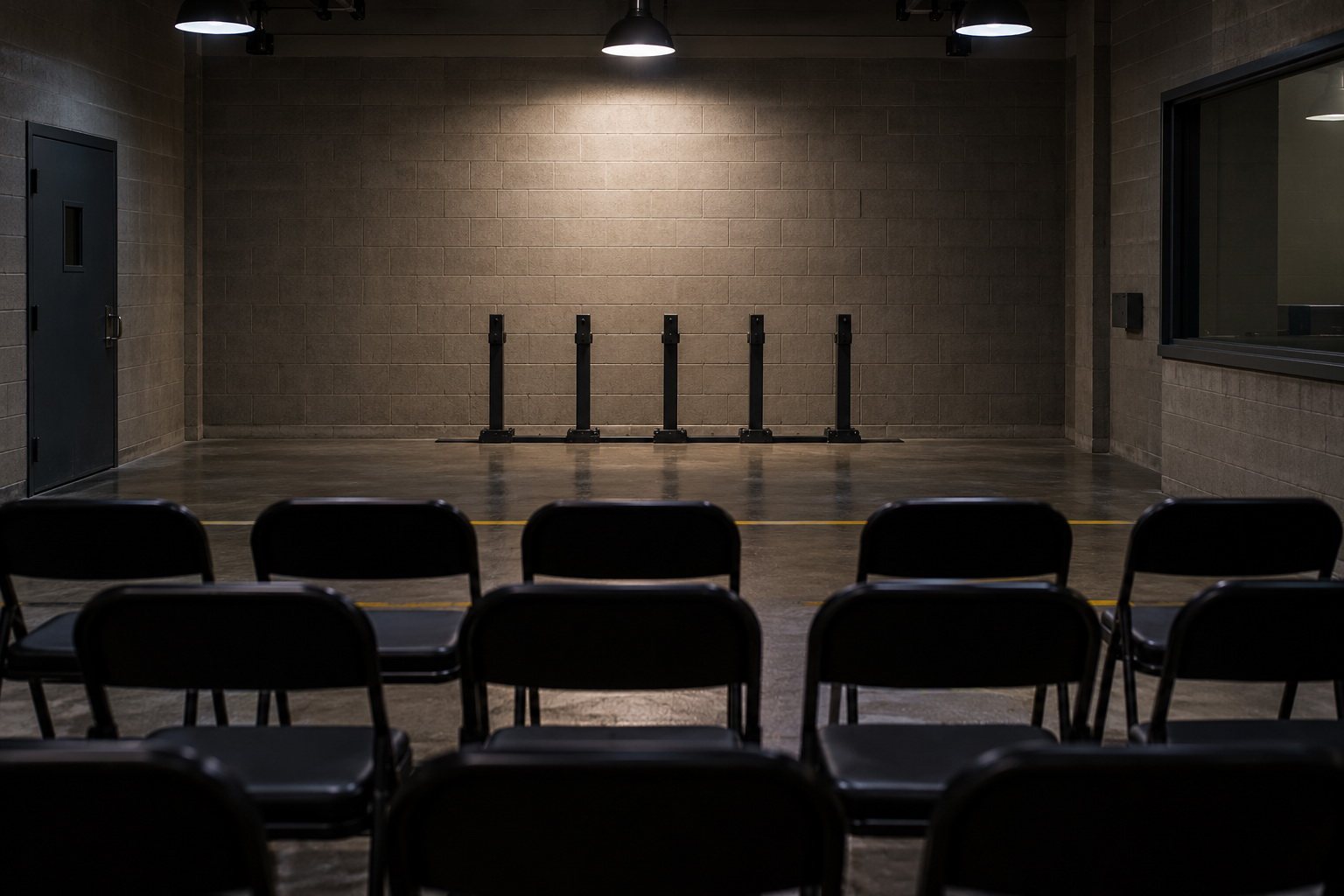
For generations, Americans have associated public executions with authoritarian governments, religious extremism and some of the darkest chapters of human history.
Iran publicly hangs prisoners. North Korea has assembled crowds to witness firing squads. Afghanistan's Taliban government has conducted executions before thousands of spectators.
Now, under President Donald Trump, the United States Department of Defense is preparing to broadcast the execution of a prisoner to the public over the internet.
Defense Secretary Pete Hegseth has announced plans to execute convicted Fort Hood mass murderer Nidal Malik Hasan by firing squad on December 3, 2026. The Pentagon confirmed Thursday that the execution is intended to be livestreamed.
The announcement has generated extraordinary condemnation from Republicans, Democrats, conservative commentators and military legal experts.
It has also raised a deeply uncomfortable question: Why is the United States embracing a practice Americans have spent decades condemning when other governments carry it out?
A Military Execution Turned Into a Public Broadcast
Hasan, a former Army psychiatrist, murdered 13 people and wounded 32 others during a shooting at Fort Hood, Texas, on November 5, 2009.
He was convicted by a military court in 2013 and sentenced to death.
There is little dispute about the seriousness of his crimes. Even several prominent critics of Hegseth's announcement have explicitly stated that they believe Hasan deserves execution.
The controversy is not simply about capital punishment. It is about the government's decision to transform an execution into something potentially accessible to millions of viewers.
Speaking to conservative commentator Jack Posobiec, Hegseth said the execution would be carried out by soldiers and made available for public viewing.
The Pentagon subsequently confirmed that the execution would be livestreamed.
If the plan proceeds, it would be the first American military execution since 1961 and the first known U.S. military execution broadcast live to the general public.
Iran: Public Executions as Displays of State Power
Iran is among the countries most closely associated with public executions.
The Iranian government has conducted hangings in public squares and other locations, sometimes before assembled crowds.
Human rights organizations have documented the practice for years, criticizing its use as public intimidation and its consequences for human dignity.
According to Amnesty International, Iran carried out at least 11 public executions in 2025.
The comparison with the Trump administration's proposal is especially striking because Trump has repeatedly criticized Iran's treatment of prisoners and protesters.
In January 2026, Trump publicly welcomed reports that Iranian authorities had stopped planned executions. He subsequently cited his opposition to Iranian executions while discussing his administration's confrontation with Tehran.
Now his own administration is planning to make an execution publicly viewable.
The circumstances of Hasan's conviction are very different from the politically motivated prosecutions and human rights abuses documented in Iran. But the decision to deliberately expose the public to a state killing creates an unmistakable comparison in the way governments present capital punishment.
North Korea: Firing Squads Before Assembled Crowds
North Korea offers another troubling comparison.
The authoritarian government has long been accused of using public executions to frighten its population and demonstrate the consequences of disobedience.
In a February 2026 report, Amnesty International documented testimony from North Korean escapees who described executions carried out before enormous crowds.
Some witnesses said they had been forced to attend executions while still in school.
The punishments described included firing squads, sometimes involving prisoners accused of distributing foreign television programs or other prohibited media.
One witness described tens of thousands of people gathering for an execution.
The underlying message was unmistakable: the government wanted people to witness the punishment.
Hegseth has offered a deterrence rationale for making Hasan's execution public, arguing that people should understand the consequences of such crimes.
The American military justice system is not equivalent to North Korea's arbitrary and repressive system. Nevertheless, the use of an execution as a public warning is a point of comparison that deserves scrutiny.
Afghanistan: The Taliban's Public Executions
Since returning to power in 2021, Afghanistan's Taliban government has resumed public executions under its interpretation of Islamic law.
These executions have sometimes taken place in stadiums or other public venues before large crowds.
Amnesty International documented at least six public executions in Afghanistan during 2025.
International human rights organizations have condemned the practice, particularly amid concerns about judicial procedures and the treatment of defendants.
Public executions under the Taliban are intended in part to demonstrate the enforcement of the government's interpretation of religious law.
While the legal and political circumstances differ sharply from the United States, the public staging of a government killing remains a common feature.
Saudi Arabia and Somalia: Other Examples
Saudi Arabia has a documented history of public executions, including beheadings, although executions there are not all conducted publicly and the frequency of public spectacles has varied.
Somalia has also experienced public executions, particularly in areas controlled by armed groups and in some cases involving security authorities.
These countries are frequently cited in discussions of public capital punishment, although their practices differ substantially and should not be treated as identical.
The United States would not be joining a group of countries that all livestream executions. Rather, it would be adopting a new form of public access to capital punishment that is extraordinarily unusual in modern American practice.
America Abandoned Public Executions Nearly 90 Years Ago
The United States once had its own long history of public hangings.
During the 18th and 19th centuries, executions sometimes attracted thousands of spectators. They could become chaotic gatherings involving vendors, crowds and public entertainment.
Over time, Americans increasingly rejected the practice.
One of the last widely recognized public executions occurred in Owensboro, Kentucky, in August 1936, when Rainey Bethea was hanged before a crowd estimated at approximately 20,000 people.
The spectacle attracted widespread criticism and helped accelerate the movement away from public executions.
Today, American executions generally take place inside correctional facilities before a limited number of authorized witnesses, including representatives of victims' families, journalists and officials.
The Pentagon's proposal would reverse that longstanding separation between capital punishment and mass public viewing.
And it would do so using technology that could make the execution available not merely to a crowd of thousands, but potentially to millions of people around the world.
Republicans and Democrats Condemn Hegseth's Plan
The backlash has crossed political lines.
Republican Senator Thom Tillis of North Carolina supported carrying out Hasan's death sentence but strongly objected to broadcasting it, comparing the proposal to practices associated with Iran and Afghanistan.
Former Trump White House communications director Alyssa Farah Griffin, who supports capital punishment for terrorists, warned that livestreaming an execution would be harmful to society.
Conservative commentator Robby Soave raised another concern: publicly broadcasting the death of a convicted terrorist could provide extremist organizations with propaganda material.
Democratic Senator Chris Murphy condemned the proposal and questioned whether the administration was imitating the execution spectacles associated with ISIS.
Representative Betty McCollum, a Minnesota Democrat, called for the public execution plan to be stopped while acknowledging the severity of Hasan's crimes.
Their objections differ in emphasis, but share a central concern: the government should not turn the taking of a human life into a public broadcast.
What Purpose Does Broadcasting an Execution Serve?
Supporters of the death penalty often argue that executions provide justice for victims, accountability for serious crimes and a deterrent against future violence.
Hegseth has emphasized deterrence in explaining his desire for a public execution.
But those arguments do not establish that an execution needs to be livestreamed.
Hasan has already been convicted and sentenced. The military can carry out a lawful death sentence without broadcasting it.
Making the execution available online introduces additional questions.
Would the recording remain publicly accessible? Could it be downloaded, edited and distributed across social media? Could extremist organizations use the footage for recruitment or propaganda? What would the broadcast mean for victims' families who do not want their relatives' murders associated with a televised spectacle?
The Pentagon has not publicly provided a detailed explanation of how the livestream would operate or what restrictions would apply.
Legal experts have also cautioned that further court proceedings could delay the scheduled execution.
A Disturbing New Precedent for the United States
The distinction between a judicial execution and a public spectacle is not a minor procedural matter.
It reflects a decision about how a government exercises its most irreversible power.
For decades, the United States has criticized governments that use public executions to intimidate populations, dramatize punishment or display state authority.
The Trump administration's proposed livestream does not make the American justice system identical to those of Iran, North Korea or Taliban-controlled Afghanistan. The differences in legal protections, political freedoms and judicial procedures remain substantial.
But the comparison raises a legitimate question about the standards the United States chooses to uphold.
A convicted mass murderer can be held accountable without transforming his death into an internet event.
If the Pentagon proceeds with its plan on December 3, the United States will cross a line it has avoided for generations.
The question is not whether Hasan's crimes were horrific. They were.
The question is why the American government believes the public needs to watch him die.